Site inventory
In a clinical trial, sites are the locations that cover various study activities intended for subject treatment and data collection. One such activity managed via IWRS is dispensation—the process of providing subjects with items. To satisfy this process, there is a need to request, ship, maintain, and account for items.
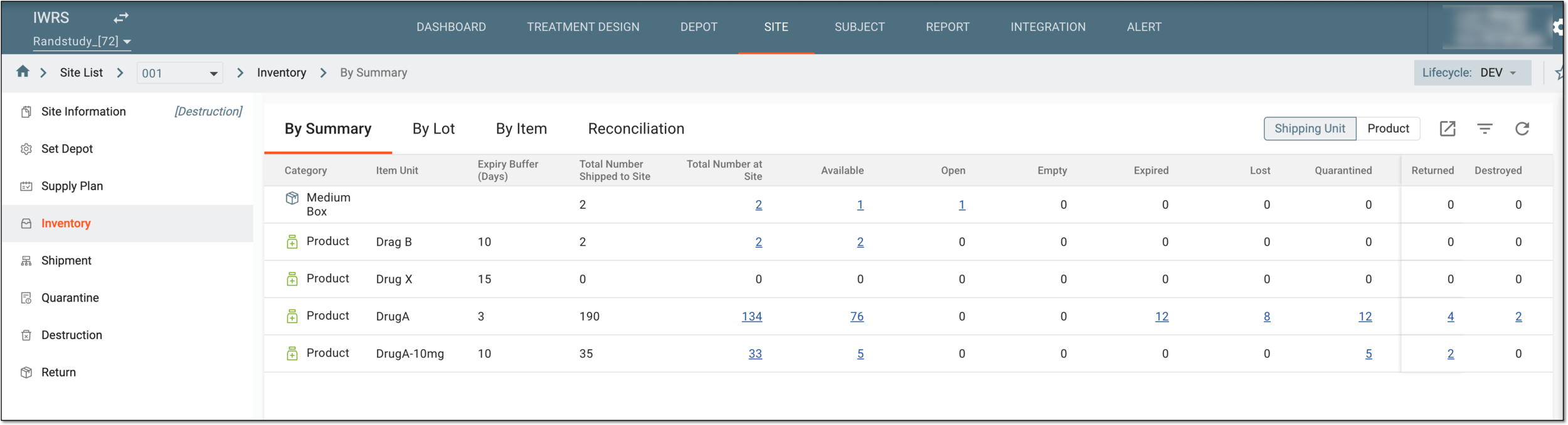
For your convenience and efficient management of site inventories, the item statistics are given from three different perspectives—by summary, lot, and item—as explained in detail in the following sections.
Under the By Summary tab, the statistics are given for all items accounted for in a site. The data can be organized by product units or container units based on your study configurations.
Important
If no container units are configured in IWRS, then all operations in Inventory occur in product units.
The inventory summary provides you with the complete picture of how many items or containers of different product are there in a site. Each value in the table that is not zero is an active link for you to navigate to the By Item tab for more detailed statistics.

In the following table, you can find the description of each element of the By Summary tab.
|
Element |
Details |
|---|---|
|
Shipping Unit/Product |
Switch between these filters to display the inventory statistics either by both shipping units (containers and products) or only by products.
|
|
Category |
Represents one of the following:
|
|
Item Unit |
Represents the name of the product.
|
|
Expiry Buffer (Days) |
Represents the buffer period in days set for the shipment of the product or container unit to prevent untimely drug expiry.
|
|
Total Number Shipped to Site |
Represents the total number of product or container units shipped to the site by its suppliers. |
|
Total Number at Site |
Represents the total number of product or container units that are currently at the site in various dispositions excluding the items of the Destroyed disposition. Select this number to go to the By Item tab where the statistics for the selected item unit are displayed. |
|
Available |
Represents the number of product or container units that are available for dispensation or shipment. Select this number to go to the By Item tab, where the statistics for the selected item unit are displayed and filtered by the Available disposition. |
|
Expired |
Represents the number of expired product or container units. Select this number to go to the By Item tab, where the statistics for the selected item unit are displayed and filtered by the Expired disposition. |
|
Lost |
Represents the number of lost product or container units. Select this number to go to the By Item tab, where the statistics for the selected item unit are displayed and filtered by the Lost disposition. |
|
Quarantined |
Represents the number of quarantined product or container units. Select this number to go to the By Item tab, where the statistics for the selected item unit are displayed and filtered by the Abnormal group of disposition. |
|
Damaged |
Represents the number of damaged product or container units. Select this number to go to the By Item tab, where the statistics for the selected item unit are displayed and filtered by the Abnormal disposition. |
|
Pending Disposal |
Represents the number of product or container units that have to be returned or are ready to be destroyed. Select this number to go to the By Item tab, where the statistics for the selected item unit are displayed and filtered by the Pending Disposal disposition. |
|
Dispensed |
Represents the number of product or container units that have been dispensed and now obtain one of the following statuses: Dispensed (in Subjects), Dispensed (Wasted), or Dispensed (Returned). Select this number to go to the By Item tab, where the statistics for the selected item unit are displayed and filtered by the Dispensed disposition. |
|
In Transit |
Represents the number of product or container units that are currently transferred from a supplier depot or elsewhere. Select this number to go to the By Item tab, where the statistics for the selected item unit are displayed and filtered by the In Transit disposition. |
|
Returned |
Represents the number of product or container units that are returned to the supplier by the site. Select this number to go to the By Item tab, where the statistics for the item unit are displayed and filtered by the Returned disposition. |
|
Destroyed |
Represents the number of product or container units that are destroyed by the site. Select this number to go to the By Item tab, where the statistics for the item unit are displayed and filtered by the Destroyed disposition. |
Important
There can be more columns in the table if any custom item dispositions are created for your study.
A packaging lot is a batch of items that can belong to different product units but are collected into one package to be released (shipped) to the site or for other logistic purposes. Thus, it is very convenient to have the inventory statistics organized by lots, so that to analyze how many items of each lot are accounted for in the depot.
The data in the By Lot table can be organized by product units or container units based on your study configurations.
Important
If no container units are configured in IWRS, then all operations in Inventory occur in product units.

Each value in the By Lot table that is not zero is an active link that you can select to navigate to the By Item tab for more detailed statistics on the items of a certain disposition.
In the following table, you can find the description of each element of the By Lot tab.
|
Element |
Details |
|---|---|
|
Shipping Unit/Product |
Switch between these filters to display the inventory statistics either by both shipping units (containers and products) or only by products.
|
|
Category |
Represents one of the following:
|
|
Item Unit |
Represents the name of the product.
|
|
Expiry Buffer (Days) |
Represents the buffer period in days set for the shipment of the product or container unit to prevent untimely drug expiry.
|
|
Lot Number |
Represents the unique number of the packaging lot to which the product or container unit belongs. |
|
Expiration Date of Lot |
Represents the default expiration date of the packaging lot to which the item unit belongs. |
|
Total Number Shipped to Site |
Represents the total number of product or container units shipped to the site by its suppliers. |
|
Total Number at Site |
Represents the total number of product or container units that are currently at the site in various dispositions excluding the items of the Destroyed disposition. Select this number to go to the By Item tab where the statistics for the selected item unit are displayed. |
|
Available |
Represents the number of product or container units that are available for shipment. Select this number to go to the By Item tab, where the statistics for the selected item unit are displayed and filtered by the Available disposition. |
|
Expired |
Represents the number of expired product or container units. Select this number to go to the By Item tab, where the statistics for the selected item unit are displayed and filtered by the Expired disposition. |
|
Lost |
Represents the number of lost product or container units. Select this number to go to the By Item tab, where the statistics for the selected item unit are displayed and filtered by the Lost disposition. |
|
Quarantined |
Represents the number of quarantined product or container units. Select this number to go to the By Item tab, where the statistics for the selected item unit are displayed and filtered by the Abnormal group of disposition. |
|
Damaged |
Represents the number of damaged product or container units. Select this number to go to the By Item tab, where the statistics for the selected item unit are displayed and filtered by the Abnormal disposition. |
|
Pending Disposal |
Represents the number of product or container units that have to be returned or are ready to be destroyed. Select this number to go to the By Item tab, where the statistics for the selected item unit are displayed and filtered by the Pending Disposal disposition. |
|
Dispensed |
Represents the number of product or container units that have been dispensed and now obtain one of the following statuses: Dispensed (in Subjects), Dispensed (Wasted), or Dispensed (Returned). Select this number to go to the By Item tab, where the statistics for the selected item unit are displayed and filtered by the Dispensed disposition. |
|
In Transit |
Represents the number of product or container units for the item unit that are currently transferred from a supplier depot or elsewhere. Select this number to go to the By Item tab, where the statistics for the selected item unit are displayed and filtered by the In Transit disposition. |
|
Returned |
Represents the number of product or container units that are returned to the supplier by the site. Select this number to go to the By Item tab, where the statistics for the item unit are displayed and filtered by the Returned disposition. |
|
Destroyed |
Represents the number of product or container units that are destroyed by the site. Select this number to go to the By Item tab, where the statistics for the item unit are displayed and filtered by the Destroyed disposition. |
Important
There can be more columns in the table if any custom item dispositions are created for your study.
The By Item tab gives you detailed information on each item accounted for in a site inventory: its label package number, disposition, expiration date, and so on.
The data in the By Item table can be organized by product units or container units based on your study configurations.
Important
If no container units are configured in IWRS, then all operations in Inventory occur in product units.
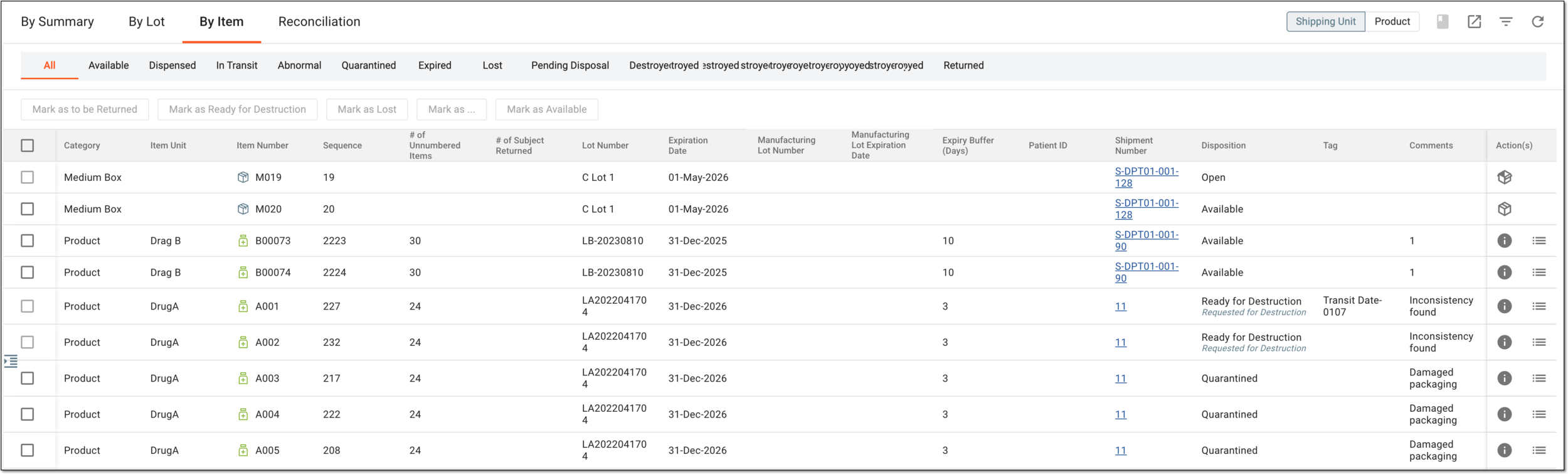
In the following table, you can find the description of each element of the By Item tab.
|
Element |
Details |
|---|---|
|
Shipping Unit/Product |
Switch between these filters to display the inventory statistics either by both shipping units (containers and products) or only by products.
|
|
Item disposition filters |
Select the needed tile (Available, Dispensed, In Transit, and so on) to filter the inventory by disposition and display only the pertaining product or container units. |
|
Category |
Represents one of the following:
|
|
Item Unit |
Represents the name of the product unit. This is a blinded field, meaning that the value of this field is displayed as Blind unless the user has the Unblind View permission granted to them via the ADMIN application.
|
|
Item Number |
Represents the unique number of the product or container unit. |
|
Sequence |
Represents the sequential number of the product or container unit assigned to it in the system. |
|
# of Unnumbered Item |
Represents the number of unnumbered subitems within the item. For instance, if an item is a vial of pills, the number of pills in a vial is the value for this column.
|
|
# of Subject Returned |
Represents the number of unnumbered items returned by subjects and registered in the system under the SUBJECT tab via the Subject Dispensing functionality.
|
|
Lot Number |
Represents the unique identifier of a packaging lot to which the product or container unit belongs. |
|
Expiration Date |
Represents the expiration date configured for the packaging lot and indicating when the product or container unit expires. |
|
Manufacturing Lot Number |
Represents the unique identifier of a manufacturing lot to which the product unit belongs. |
|
Manufacturing Lot Expiration Date |
Represents the expiration date configured for the manufacturing lot and indicating when the product unit expires.
|
|
Expiry Buffer (Days) |
Represents the number of days set as an expiration buffer. The buffer period prevents subjects from getting and taking items that are about to expire.
|
|
[Unique ID Label] |
Represents a unique identifier assigned to a subject to whom the items are dispensed or who returned the items.
|
|
Shipment Number |
Represents the product or container unit's latest shipment number (or so-called shipment ID). Select the number to navigate to the corresponding shipment details page. |
|
Disposition |
Represents a current disposition of the product or container unit (open, available, in transit, expired, lost, and so on). |
|
Tag |
Represents the manually added tag, if any. Tags do not have any system logic, they are used as markers only. ImportantYou cannot add tags to container units. |
|
Comments |
Represents a comment added to the product or container unit, if any. |
In the site inventory by item, you can filter items by their disposition, manage the item disposition, view item information, pack or unpack containers, and view the item audit data following the same logic that applies to the depot inventory.