Dynamic randomization
Randomization helps you avoid potential bias in the selection and allocation of subjects arising from the predictability of treatment assignments. From a statistical perspective, randomization provides unbiased estimates of error variance and independence of errors.
The dynamic randomization method adjusts the allocation probabilities based on the current distribution of participants by running the defined arm selector. The arm selector is a component of the randomization algorithm that determines the treatment arm to which a new participant is allocated based on certain predefined criteria or rules.
Thus, when each patient comes to the study, the system assesses their compliance with established factors, evaluates the existing patient groups and site imbalance, and allocates the new patient to the most imbalanced group. Unlike permuted block randomization, dynamic randomization does not involve the predefined randomization list and offers more adaptivity to achieve arm balance at all times.
For dynamic randomization, the IWRS configuration process involves the following activities:
All the dynamic randomization schemes that you have previously added to your cohort can be found under the Randomization List module of your cohort.
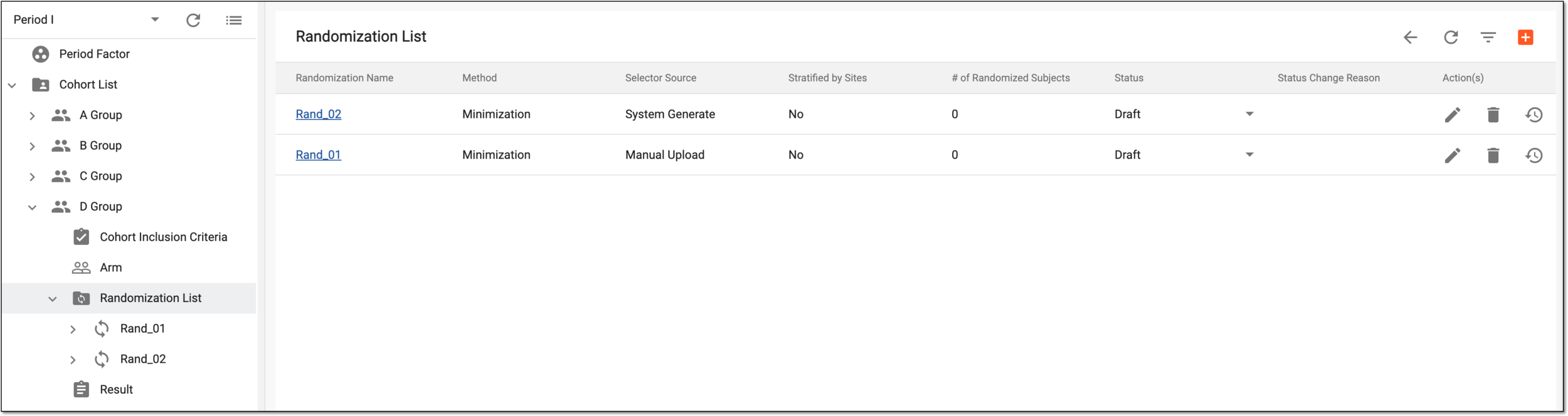
|
Column |
Details |
|---|---|
|
Randomization Name |
Represents the randomization scheme name. |
|
Method |
Represents the method of the randomization scheme. For dynamic randomization, the system currently supports only the Minimization method. |
|
Selector Source |
Represents the method of arm selector configuration:
|
|
Stratified by Sites |
Represents whether the randomization scheme has been created with the Stratified by Sites option enabled. When this option is enabled, the site is automatically used as the stratification factor. |
|
# of Randomized Subjects |
Represents the current number of subjects randomized according to the scheme. |
|
Status |
Represents the status of the randomization scheme and provides an option to change the status. The randomization scheme statuses can be as follows.
|
|
Status Change Reason |
Represents the reason for changing the scheme’s status. For instance, the randomization status has been changed to Suspended, and the reason for it can be: "One of the factors reached its upper limit". |