Permuted block randomization
In IWRS, you can diversify between two randomization methods—permuted block and dynamic. This section explains the specifics and details of the configuration and management of the permuted block (PB) randomization method.
The permuted block (PB) method involves the preparation of a randomization list before initiating the randomization process for a specific cohort. According to this method, the subjects of the specific cohort are first divided into blocks according to preset stratification factors, and then they are allocated to arms according to specific ratios. The randomization process is held by the system according to the predefined scheme—a plan according to which subjects enrolled in a study are randomized and receive treatment.
For the PB randomization scheme, the IWRS configuration process involves the following activities:
All the PB randomization schemes that you have previously added to your cohort can be found under the Randomization List module of your cohort.
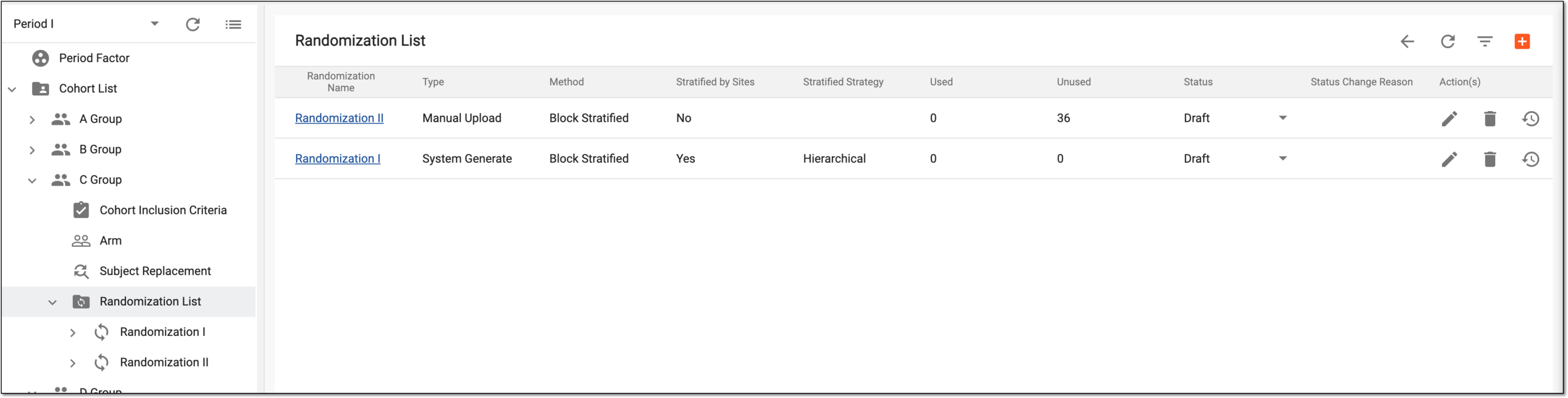
The permuted block randomization schemes have the attributes explained in the following table.
|
Column |
Details |
|---|---|
|
Randomization Name |
Represents the randomization scheme name. |
|
Type |
Represents the type of the randomization scheme. It can be either System Generate or Manual Upload. |
|
Method |
Represents the method of the randomization scheme. It can be either Block, Stratified, Block Stratified, or Complete. |
|
Stratified by Sites |
Represents whether the randomization scheme has been created with the Stratified by Sites option enabled. When this option is enabled, the site is automatically used as the stratified factor with the highest priority. |
|
Stratification Strategy |
Represents the stratification strategy of the randomization scheme:
|
|
Used |
Represents the number of randomization IDs used. |
|
Unused |
Represents the number of randomization IDs that are not used. |
|
Status |
Represents the status of the randomization scheme and provides an option to change the status. The randomization scheme statuses can be as follows.
|
|
Status Change Reason |
Represents the reason for changing the scheme’s status. For instance, the randomization status has been changed to Suspended, and the reason for it can be: "One of the factors reached its upper limit". |