File query management in essential documents
While doing quality control on clinical trial files in essential documents, you can open queries about the file content, format, attributes, and so on, and send them to specific roles or personnel.
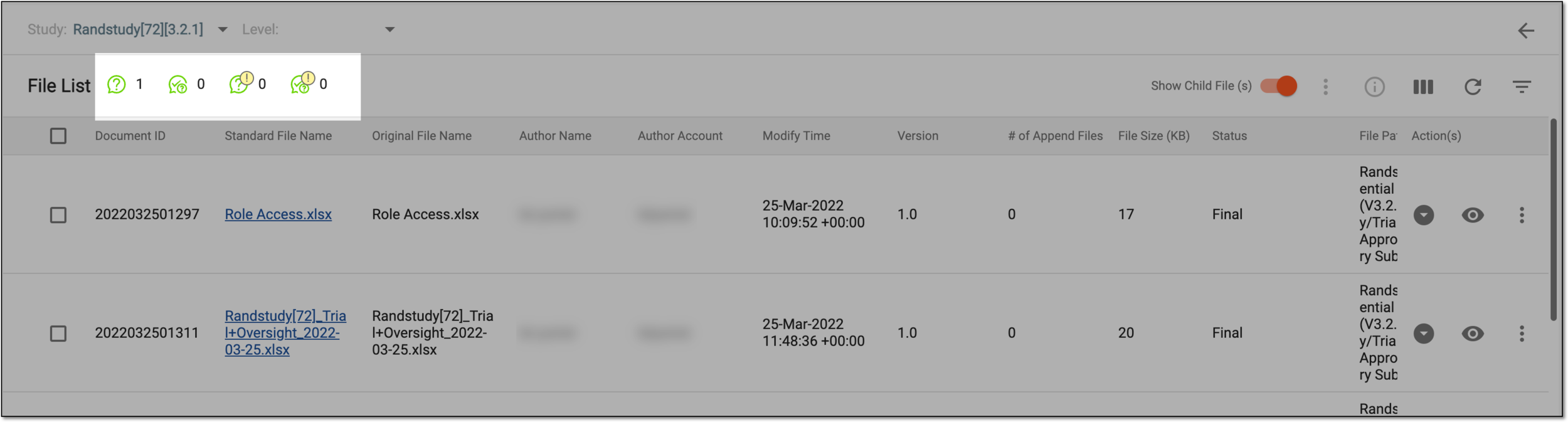
In eTMF, in the File List table of the Essential Documents directory, you can find the query block, the elements of which are explained in the following table.
|
Element |
Details |
|---|---|
|
My Open Query |
Represents the number of open queries assigned to you and awaiting for your answer. |
|
My Answered Query |
Represents the number of queries opened by you that have already been answered by the assignee. |
|
My Overdue Open Query |
Represents the number of open queries assigned to you that are past their expected due date set upon opening. |
|
My Overdue Answered Query |
Represents the number of queries opened by you that are past their expected due date and are answered by the assignee. |


In Essential Documents, you can manage your queries as discussed in the following sections.
While doing quality control on clinical trial files in essential documents, you can open queries about the file content, format, attributes, and so on, and send them to specific roles or personnel.
-
In the eTMF application header, select the TMF tab.
-
On the page that opens, in the left pane, select the Study List subtab.
-
In the Study List table, select the study for which you want to access the relevant files and documents.
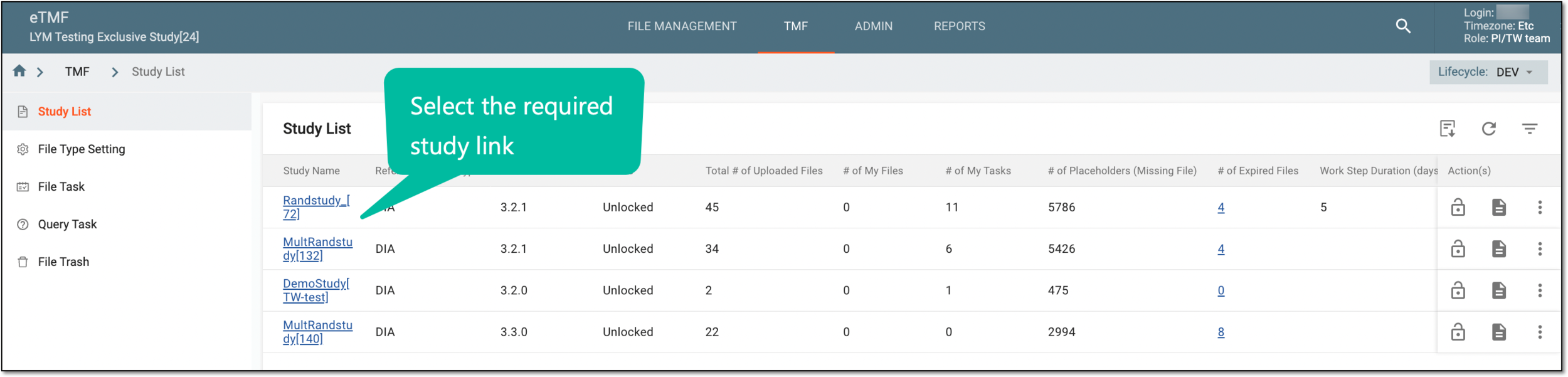 Figure 1. Selecting study
-
On the page that opens, in the left pane, select the Essential Documents subtab.
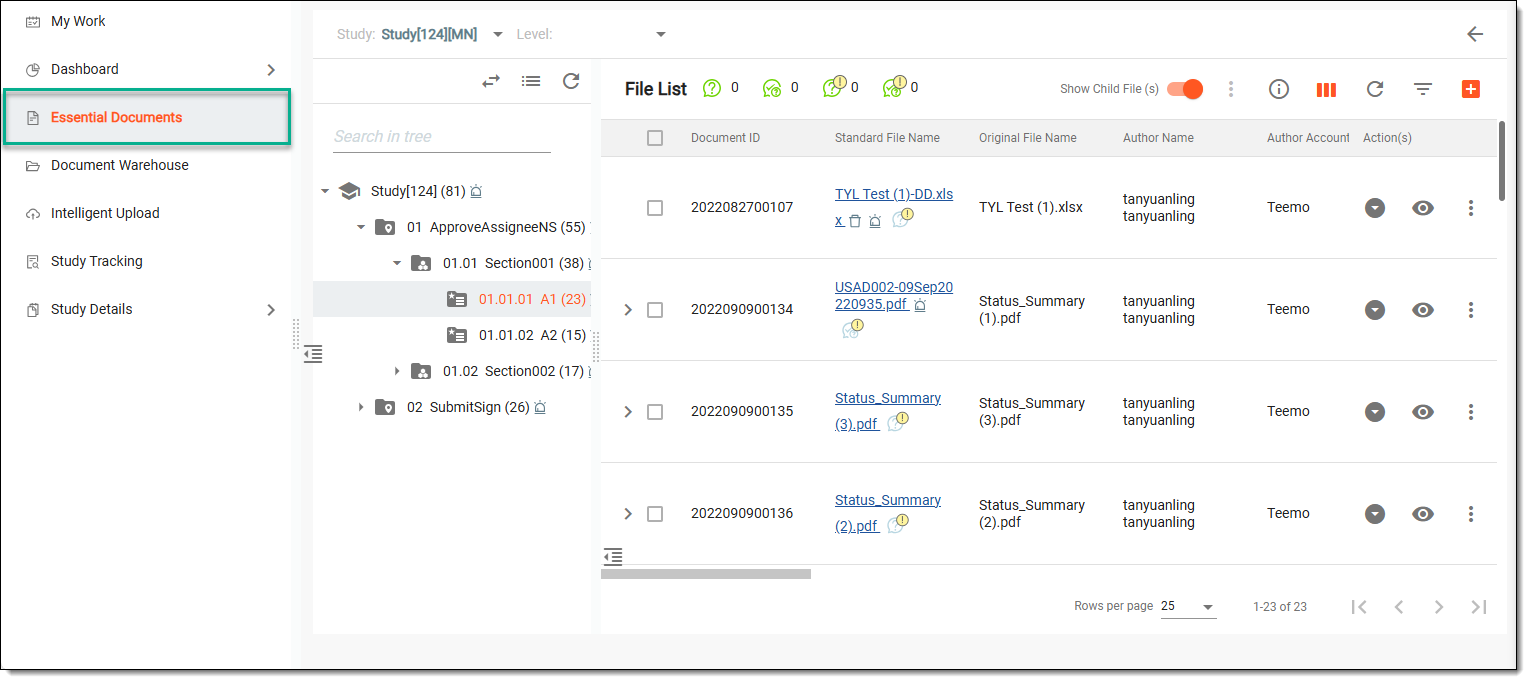 Figure 2. Accessing essential documents
-
In the explorer tree pane, select the required directory, and in the File List table that appears, locate the needed file.
-
In the Actions column next to the file, select More
 > Open Query
  .
.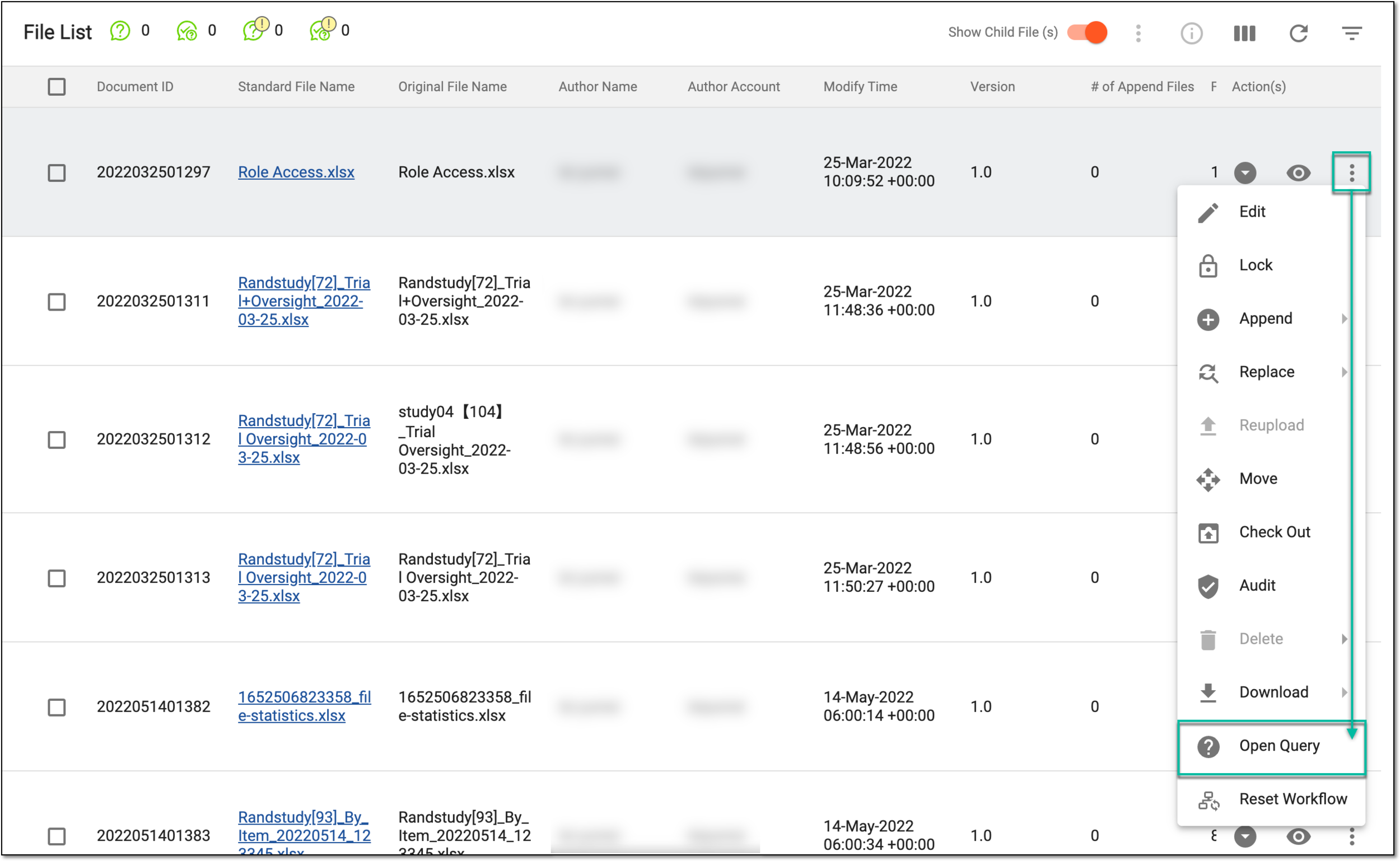 Figure 3. Opening query
-
In the Open Query dialog that opens, fill in the fields as explained in the following table.
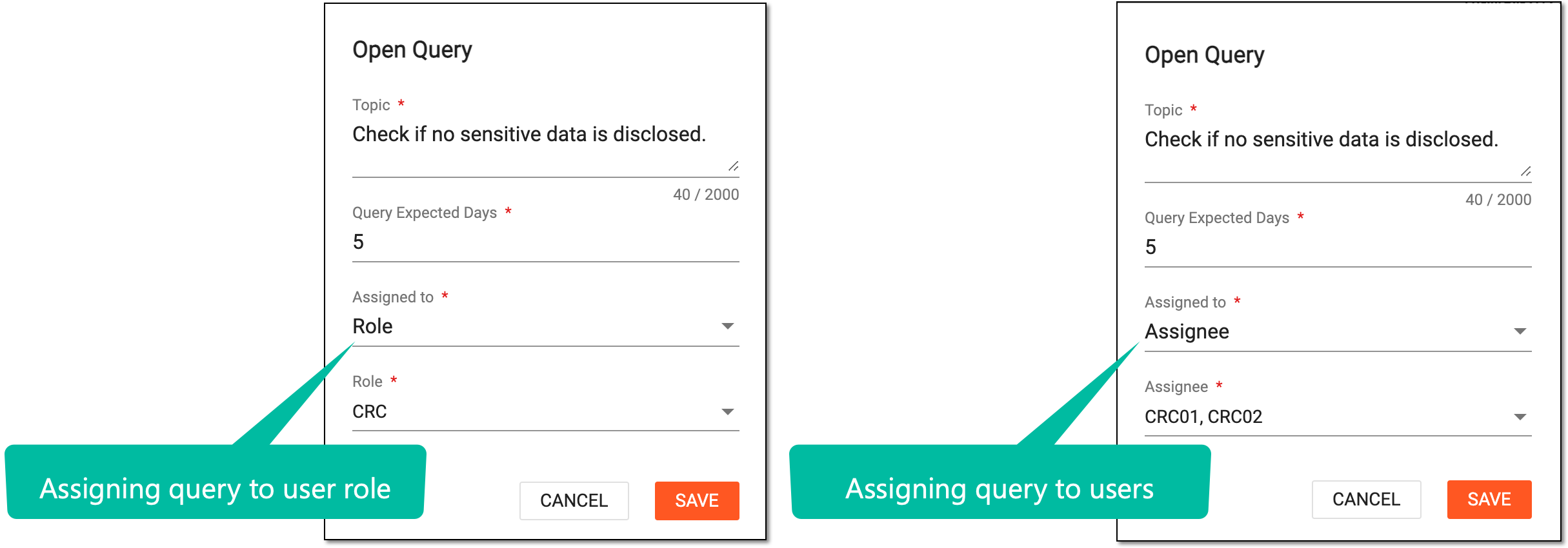 Figure 4. Opening query
Tip
In the following table, mandatory elements are marked with an asterisk (*).
Element
Details
Topic*
Enter the descriptive topic of your query that you want the assignee to address.
Query Expected Days*
Enter the number of days to define the query expiration period.
You can set the expected days value for all your queries with the Study Configuration feature. Then the number is predefined upon opening a new query. Nevertheless, it is always editable.
Assigned to*
Select to whom you want to address the query—a specific group of users with the same scope of responsibilities and access rights (Role) or a certain person or people (Assignee).
Role*
Select the user role to whose representatives you want to address your query. This field becomes available if Role is selected in the Assigned to field.
For instance, if you need someone to check the file against the source document, you can select the CRC role here as they work at sites and have access to subject data in source documents.
Keep in mind, that the user role with which you currently operate the system is unavailable in the list. Thus, you cannot open a query assigned to yourself. For example, if you are logged in as CRC, the CRC role is missing from the
                                        list.
Assignee*
Select the name of the users to whom you want to address your query. This field becomes available if Assignee is selected in the Assigned to field.
For instance, if you need someone to check the file against the source document at a specific site and you know the person working there, you can select their name here and they will address your inquiry.
Keep in mind, that your own user name is unavailable in the list. Thus, you cannot open a query assigned to yourself.SAVE
Select
 to implement the changes.
CANCEL
Select
 to discard the changes and close the dialog.
Upon saving, the query is open and a respective icon  appears next to the file name. Now, the assigned users receive and can reply to the query.
While doing quality control on clinical trial files in essential documents, you can open queries about the file content, format, attributes, and so on, and send them to specific roles or personnel.
If there is already an open query for a file, you can also add more.
For instance, you see that someone has requested a file check against the source from CRC, but you also need to request PI confirmation that the file follows industry standards.
-
In the eTMF application header, select the TMF tab.
-
On the page that opens, in the left pane, select the Study List subtab.
-
In the Study List table, select the study for which you want to access the relevant files and documents.
Figure 1. Selecting study
-
On the page that opens, in the left pane, select the Essential Documents subtab.
Figure 2. Accessing essential documents
-
In the explorer tree pane, select the required directory and in the File List table that appears, find the file for which you need to add a query.
-
Next to the file name, select Open Query
. -
On the Query List panel that opens on the right, select
 .
. Figure 3. Selecting to add new query
-
In the Open Query dialog that opens, fill in the fields as explained in the following table.
Figure 4. Opening query
Tip
In the following table, mandatory elements are marked with an asterisk (*).
Element
Details
Topic*
Enter the descriptive topic of your query that you want the assignee to address.
Query Expected Days*
Enter the number of days to define the query expiration period.
You can set the expected days value for all your queries with the Study Configuration feature. Then the number is predefined upon opening a new query. Nevertheless, it is always editable.
Assigned to*
Select to whom you want to address the query—a specific group of users with the same scope of responsibilities and access rights (Role) or a certain person or people (Assignee).
Role*
Select the user role to whose representatives you want to address your query. This field becomes available if Role is selected in the Assigned to field.
For instance, if you need someone to check the file against the source document, you can select the CRC role here as they work at sites and have access to subject data in source documents.
Keep in mind, that the user role with which you currently operate the system is unavailable in the list. Thus, you cannot open a query assigned to yourself. For example, if you are logged in as CRC, the CRC role is missing from the
                                        list.
Assignee*
Select the name of the users to whom you want to address your query. This field becomes available if Assignee is selected in the Assigned to field.
For instance, if you need someone to check the file against the source document at a specific site and you know the person working there, you can select their name here and they will address your inquiry.
Keep in mind, that your own user name is unavailable in the list. Thus, you cannot open a query assigned to yourself.SAVE
Select
to save the implemented changes.CANCEL
Select
to discard the changes and close the dialog.
Upon saving, a new query is added to the list. Now, the assigned users receive your query and can answer it.
While doing quality control on clinical trial files in essential documents, you can open queries about the file content, format, attributes, and so on, and send them to specific roles or personnel.
Sometimes, when you have already opened a query, you might need to change something about it—clarify the topic or change the assignee. In eTMF, you can always update a query with the Edit feature.
-
In the eTMF application header, select the TMF tab.
-
On the page that opens, in the left pane, select the Study List subtab.
-
In the Study List table, select the study for which you want to access the relevant files and documents.
Figure 1. Selecting study
-
On the page that opens, in the left pane, select the Essential Documents subtab.
Figure 2. Accessing essential documents
-
In the explorer tree pane, select the required directory. Then, in the File List table that appears, locate the file for which you need to edit a query.
-
Next to the file name, select Open Query
. -
On the Query List panel that opens on the right, find the query you want to update and next to it, select Edit
 .
. Figure 3. Edit query option
-
In the Edit Query dialog that appears, update the fields as explained in the respective table of the Open query via essential documents section.
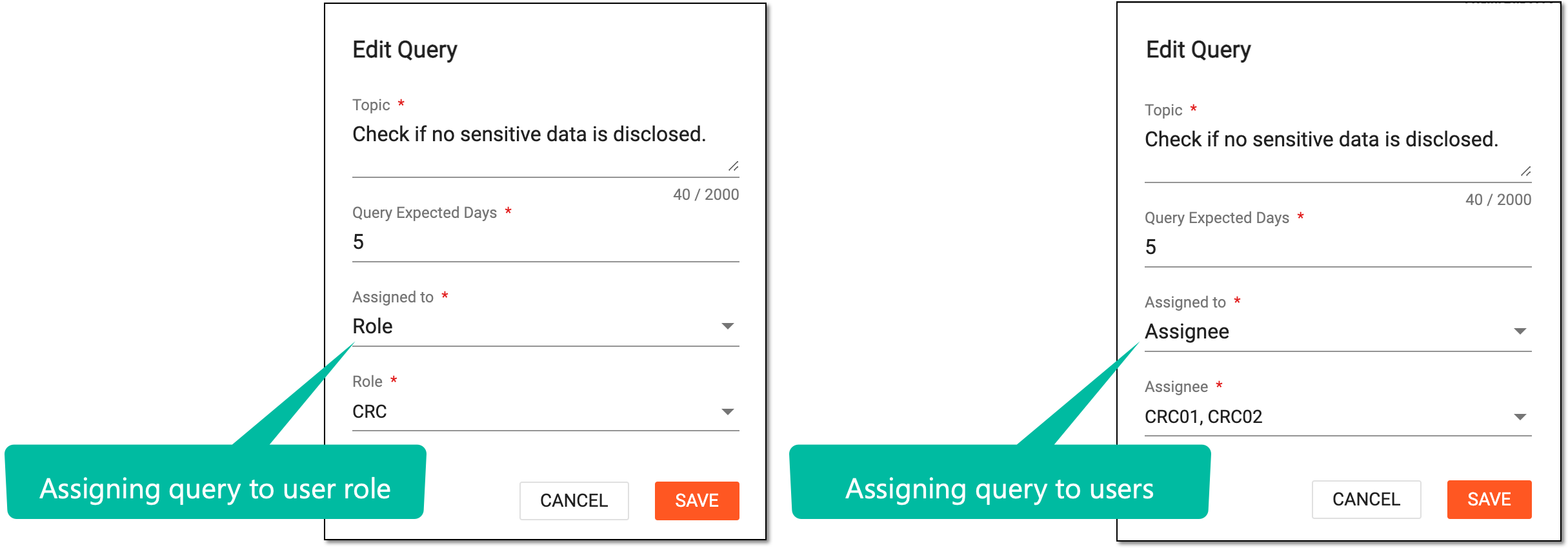 Figure 4. Editing query
-
Select
to implement the changes.
Upon saving, your query is updated.
While doing quality control on clinical trial files in essential documents, you can open queries about the file content, format, attributes, and so on, and send them to specific roles or personnel.
Sometimes, you might close a query, for instance, if you have already resolved an issue or opened your query by mistake.
Important
Users can close queries created by another user with the same role. For instance, if a CRC user has opened a query, another CRC can close it.
-
In the eTMF application header, select the TMF tab.
-
On the page that opens, in the left pane, select the Study List subtab.
-
In the Study List table, select the study for which you want to access the relevant files and documents.
Figure 1. Selecting study
-
On the page that opens, in the left pane, select the Essential Documents subtab.
Figure 2. Accessing essential documents
-
In the explorer tree pane, select the required directory, and in the File List table that appears, go to the file for which you need to close a query.
Tip
If the query that you want to close is assigned to you, you can also access it from the Query Task feature of the Quick panel.
-
Next to the file name, select Open Query
. -
On the Query List panel that opens on the right, go to the query you want to close and next to it, select Close
 .
. Figure 3. Selecting to close query
-
In the confirmation dialog that appears, select
 to close the query.
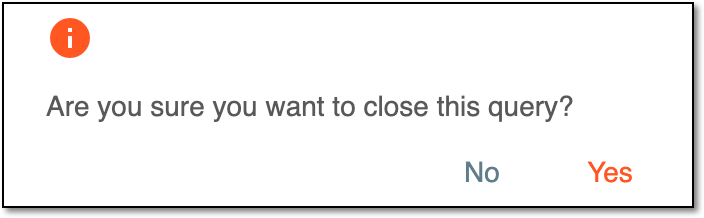 Figure 4. Confirming query closing
Upon confirmation, the query is closed, and the icon next to the file name changes to Closed Query  .
.
Queries help users of different roles address issues or check file data in a manageable and trackable way. To resolve a query means to address its topic, answer it, and (if needed) close a query.
For instance, as a CRC, you receive a query to check the file against the source and ensure data validity. You have checked that the data is identical. Thus, you answer the query stating that there are no discrepancies. The user who opened the query receives your answer and acts accordingly.
If the question is exhausted, you or the assignee can close the query.
-
In the eTMF application header, select the TMF tab.
-
On the page that opens, in the left pane, select the Query Task subtab.
-
On the Query Task page that opens, in the table, select the query you want to answer.
 Figure 1. Selecting query to answer
-
In the File List table that opens, next to the file for which the query is opened, the Query List panel is expanded. Select the query that you want to answer and in the Reply field that appears, enter your message.
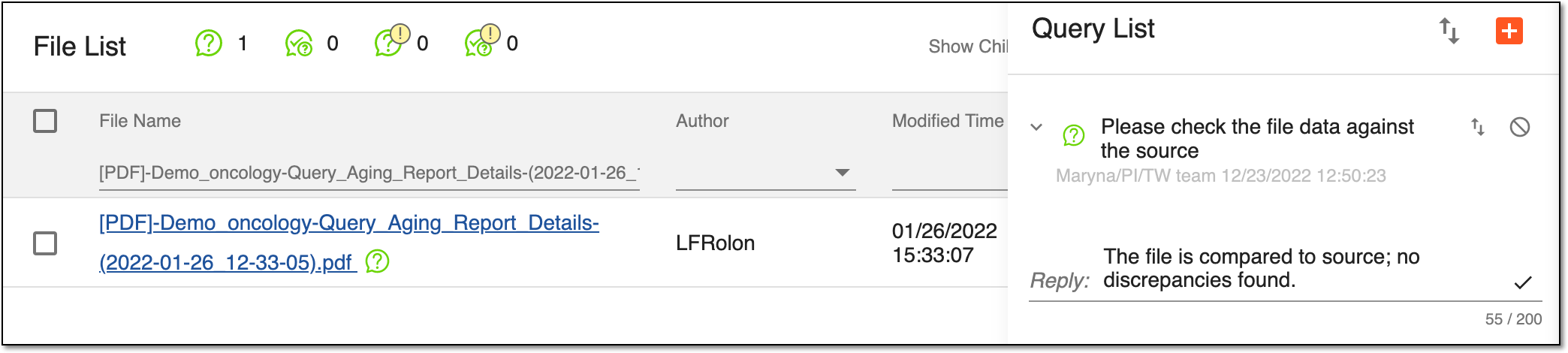 Figure 2. Answering query
-
Select
 to save your reply.
Upon saving, you have answered the query. The user who has opened the query now sees it in the list of their answered queries. You can also close a query if needed.
In eTMF, on the Query Task page, you can find all the tasks on the open queries waiting to be resolved by your user role. You can access the Query Task page under the following tabs of the eTMF application:
-
FILE MANAGEMENT > Query Task
-
TMF > Query Task
There is also an option to view the query hierarchy, meaning that you can get an easy-to-follow structure of the raised query. For example, you can check which study the query refers to, in which eTMF folder the file in question is stored, and so on.
-
In the eTMF application header, select TMF.
-
In the left pane, select Query Task.
-
On the page that opens, above the Query Task table, select Switch View
 .
. -
In the panel that opens, the query hierarchy is displayed. Drill down or up in the nodes of the hierarchy to get the structure of the raised query.
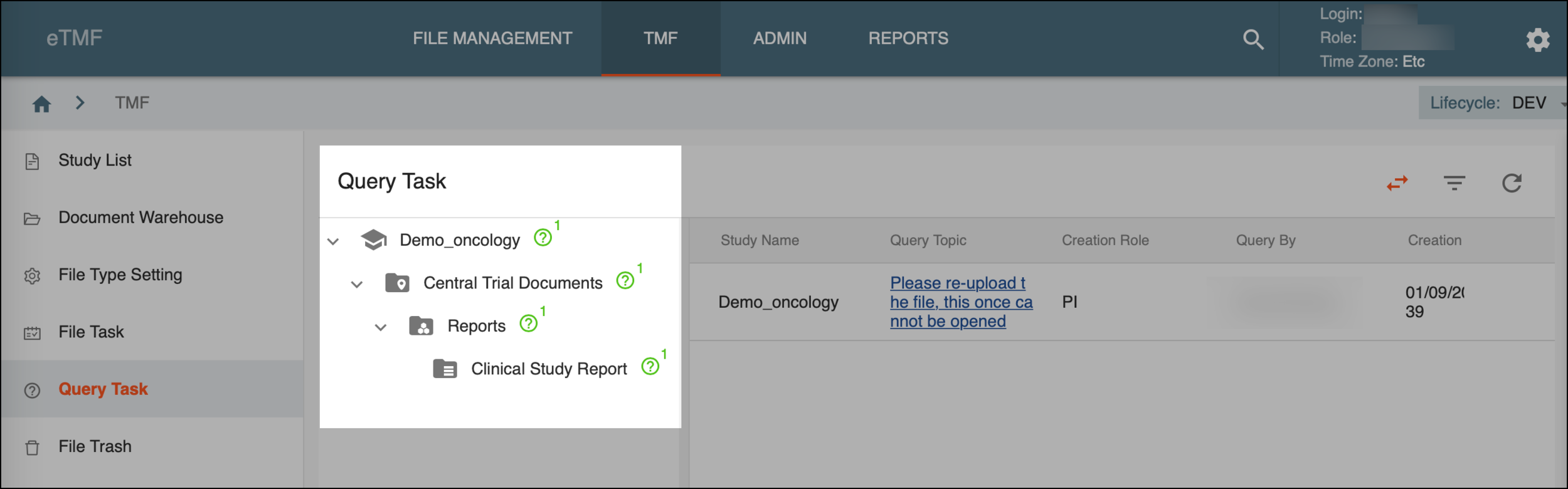 Figure 1. Navigating query hierarchy
For example, if you are investigating which study the query refers to, you can drill down and view in which folder the file in question is stored. Then drill down to the report where the problem is logged in.
-
To close the query hierarchy, select Switch View
 again.
Once done, the panel is closed. You can now focus not on the query hierarchy, but on the created queries themselves waiting to be resolved.
While doing the quality control of clinical trial documents, you can create queries to resolve an error or inconsistency discovered during data review. When you open a query, you assign a request to the user role, and the system creates a task for the query assignee(s).
On the Query Task page, you can find all the tasks on the open queries waiting to be resolved by your user role. You can access the Query Task page under the following tabs of the eTMF application:
-
FILE MANAGEMENT > Query Task
-
TMF > Query Task
The columns with data that you see on the Query Task page are explained in the following table.
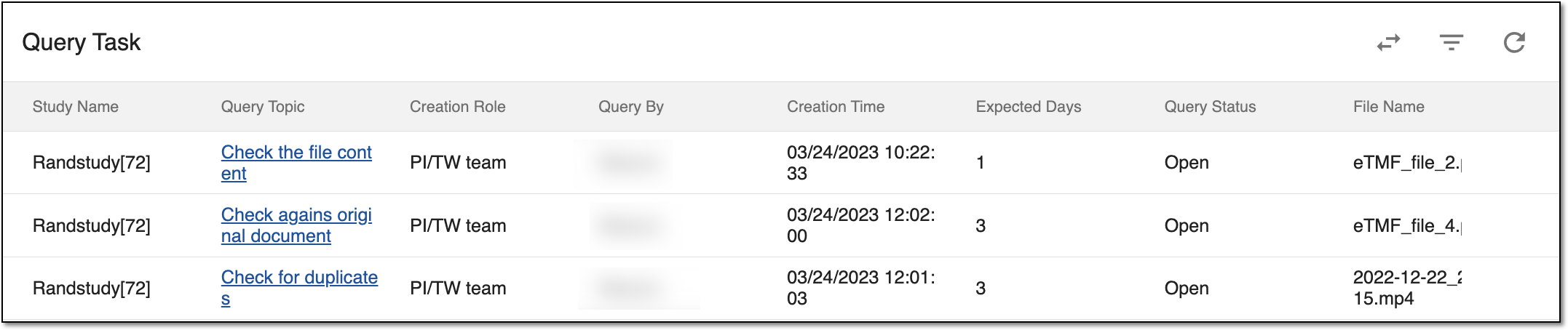
|
Columns |
Details |
|---|---|
|
Study Name |
Represents the name of the study to which the file belongs that is the subject of the query. |
|
Query Topic |
Represent the query topic entered by the user or the system upon query creation. This is an active link for you to select to open the raised query, view its details, and answer it if possible. |
|
Creation Role |
Represents the role of the user who has opened the query. |
|
Query By |
Represents the name of the user who has opened the query. |
|
Creation Time |
Represents the time and date when the query was created. |
|
Expected Days |
Represents the number of days within which the query is expected to be resolved until it becomes overdue. |
|
Query Status |
Represents the current query status. |
|
File Name |
Represents the name of the file that is the subject of the query. |
|
Version |
Represents the version of the file that is the subject of the query. |
|
Path |
Represents the path to the file that is the subject of the query. |
|
Level |
Represents the level of the file that is the subject of the query: country-, study-, or site-level. |
|
Country/Region Name |
Represents the country/region to which the file that is the subject of the query. |
|
Site Code |
Represents the code of the site to which the file that is the subject of the query. |
On the Query Task page, you can also switch to the hierarchical view to navigate between the directories with files and their queries.