Create new workflow
In eTMF, to outline the proper way of handling the files, you can create a new workflow that meets your requirements.
For example, you want all the actions with files from certain folder, such as the attempt to edit or delete them, to initiate the approval and signature of designated personnel.
You create a workflow that includes both approval and signature stages, specify dedicated users/user roles to validate the actions, and assign this workflow to the designated folder.
Once done, all the files uploaded to this folder require the approval and signature of specified users/user role representatives upon each attempted action. Thus, no one can move or delete the file unless the assigned user/role approves and signs for the action.
Important
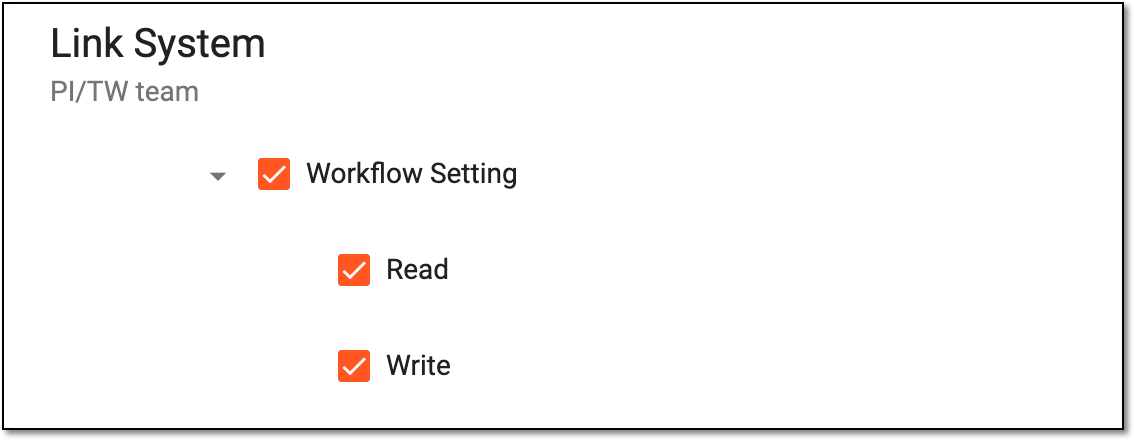
To utilize the workflow management functionality, you must have the Workflow Setting > Write permission granted to your user role via the ADMIN application.
 |
-
In the eTMF application header, select the ADMIN tab.
-
In the left pane, select the Workflow Setting subtab.
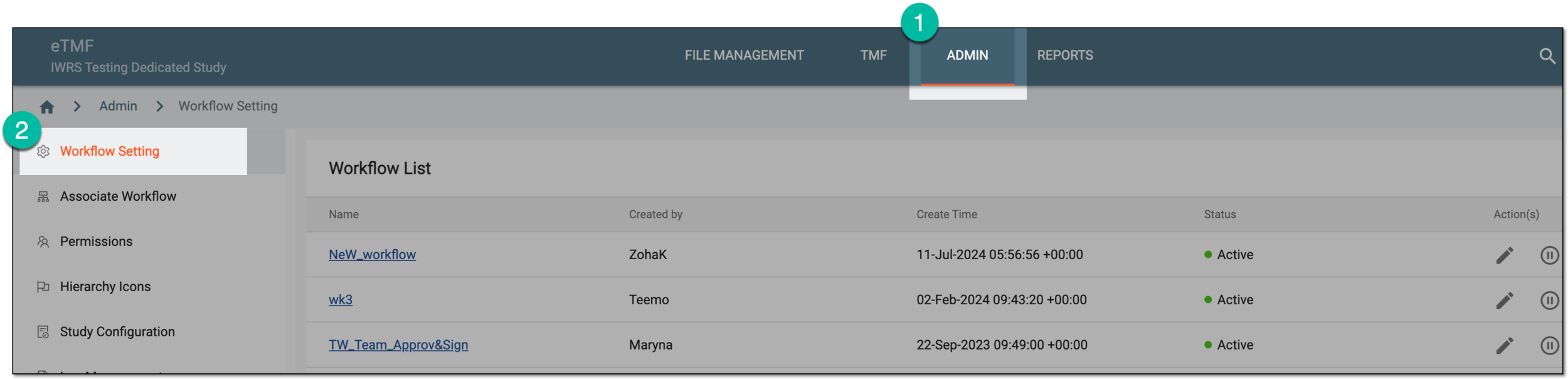 Figure 2. Accessing workflow setting
-
On the Workflow List page that opens, from the workspace toolbar, select New Item
 .
.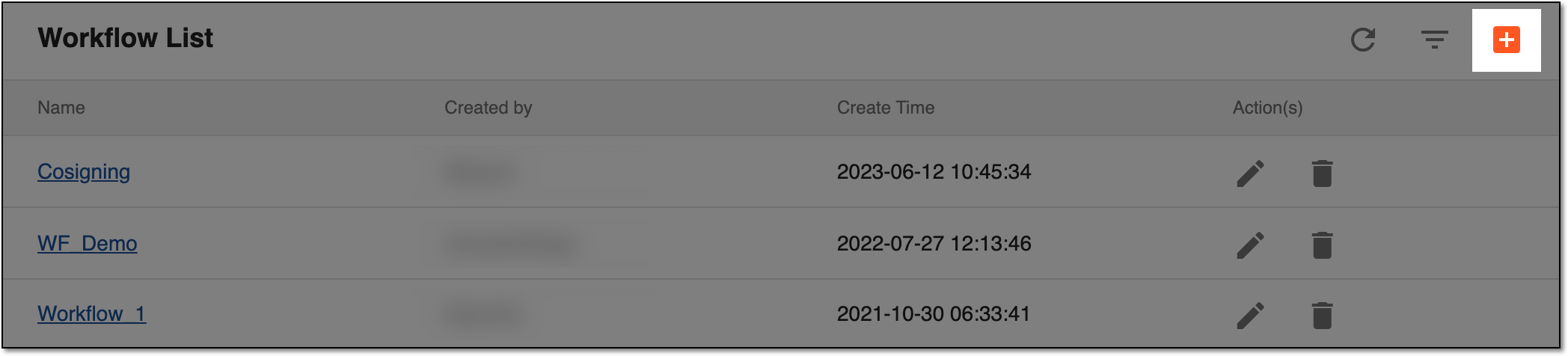 Figure 3. Adding new workflow
-
On the New Workflow panel that opens, build the workflow scheme by dragging the nodes from the left pane. The function of every node you can learn from the following table.
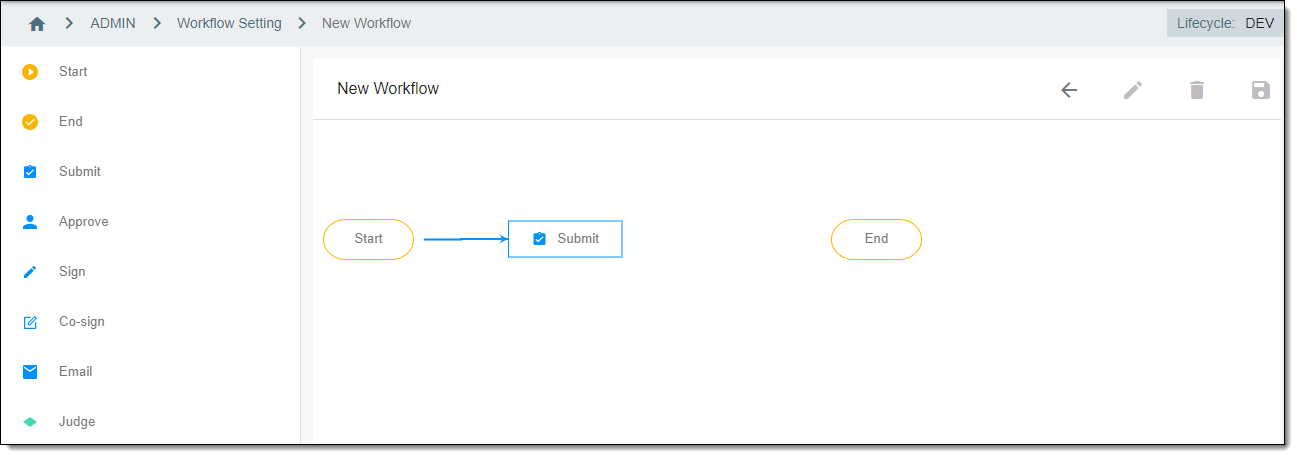 Figure 4. Building workflow scheme
Tip
The workflow must have the Start, End, Submit, and at least one of these three nodes: Approve, Sign, or Co-sign.
Node
Details
Start

Represents the beginning of the workflow process.
Whenever you create a workflow, this node is added by default. Also, the node is mandatory to add to every workflow.End

Represents the end or completion of the workflow process.
Whenever you create a workflow, this node is added by default. Also, the node is mandatory to add to every workflow.Submit

Indicates that an action with the file requires submission.
Whenever you create a workflow, this node is added by default.You can only have one consecutive node to the Submit node; you cannot link it to multiple concurrent nodes.Approve

Indicates that at a certain point, the file requires approval from designated personnel, such as a data manager (DM), principal investigator (PI), or others.
For example, when an appended file of a master file is deleted in Essential Documents, to confirm this action you may require an approval by DM.
You can only have one consecutive node to the Approve node; you cannot link it to multiple concurrent nodes.Judge

The node is automatically added if the Approve node is selected.
This node ensures two possible outcomes—approved or rejected and enables the following options:
-
Y: indicates that the action has been approved by the designated personnel. You can associate the Y node with the required task in the workflow.
For example, you can link the Y node to End, indicating that if the action is approved, then the workflow should end.
-
N: indicates that the action has been rejected by the designated personnel. You can associate the N node with the required task in the workflow.
For example, you can link the N node to Start, indicating that if the action is rejected, then the workflow should start over.
Sign

Indicates that at a certain point, the action with the file requires a signature from designated personnel, such as a DM, PI, or others.
You can only have one consecutive node to the Sign node; you cannot link it to multiple concurrent nodes.Judge
The node is automatically added if the Sign node is selected.
This node ensures two possible outcomes—signed or not signed and enables the following options:
-
Y: indicates that the designated person has signed the action. You can associate the Y node with the required task in the workflow.
For example, you can link the Y node to End, indicating that if the action has been signed, then the workflow should end.
-
N: indicates that the action has not been signed by the designated personnel. You can associate the N node with the required task in the workflow.
For example, you can link the N node to Start, indicating that if the action is not signed, then the workflow should start over.
Co-sign

Indicates that users have to cosign for the document. The list of the users to cosign for the document is specified upon uploading the file to the folder that has the Co-sign node in its associated workflow.
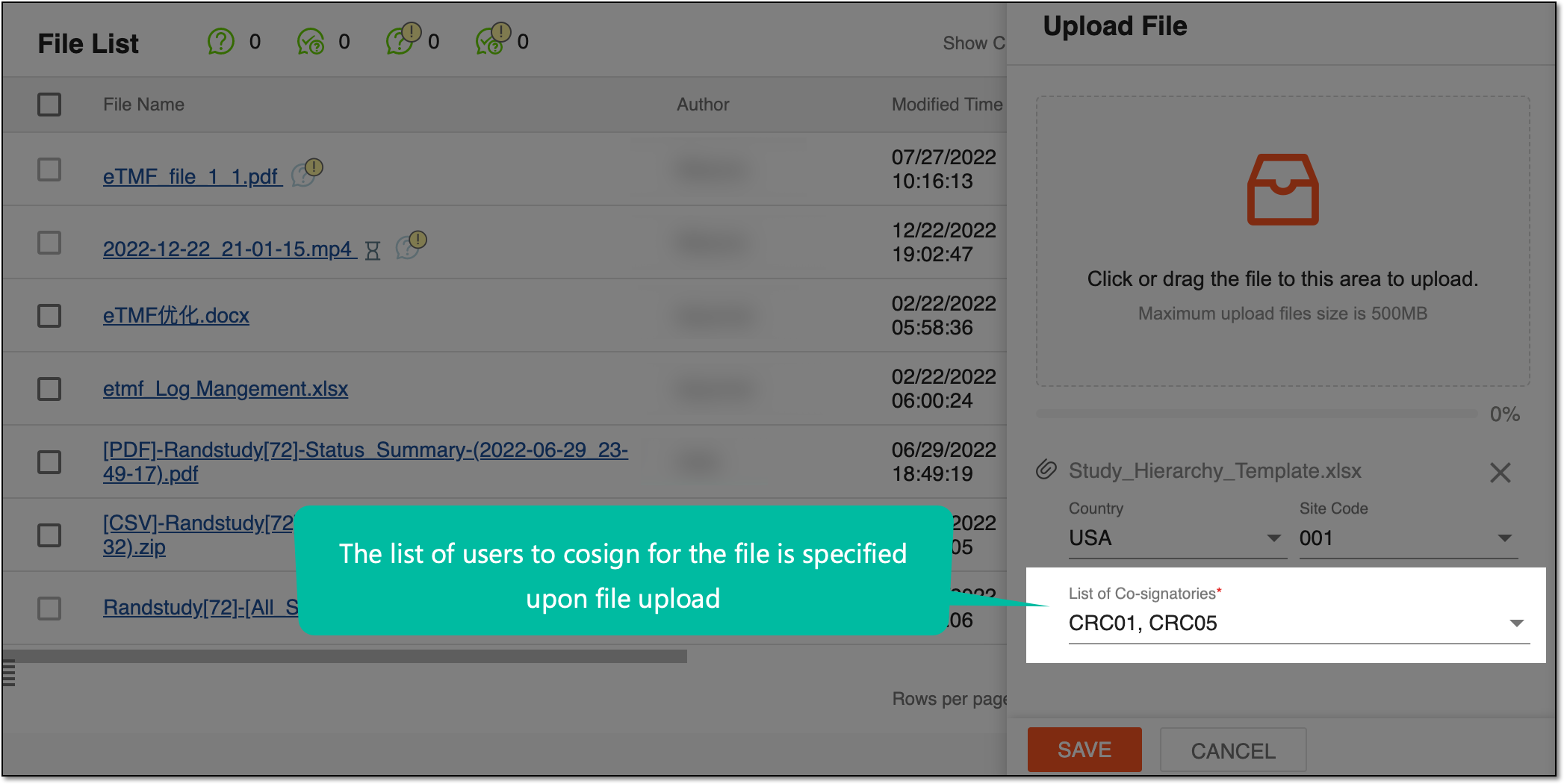 Figure 5. Specifying users to cosign for document
You can only have one consecutive node to the Co-sign node; you cannot link it to multiple concurrent nodes.Judge
The node is automatically added if the Co-sign node is selected.
This node ensures two possible outcomes—co-signed or not and enables the following options:
-
Y: indicates that all the assignees have signed the action. You can associate the Y node with the required task in the workflow.
For example, you can link the Y node to End, indicating that if the action is signed, then the workflow ends.
-
N: indicates that the action has not been signed by the assignees. You can associate the N node with the required task in the workflow.
For example, you can link the N node to Start, indicating that if the action is not signed by all the assignees, then the workflow starts over.
-
-
Once the needed nodes are added, build the connections between them by hovering over one node so that the gray dots appear on all four sides of it. Select one of the gray dots and drag the blue arrow that appears to the related node for connection.
 Figure 6. Connecting nodes
Since the Judge node has two outcomes—approval (Y) and rejection (N)—you need to connect each of them to specific nodes individually as follows:
-
Select the Judge node for Y and N options to appear.
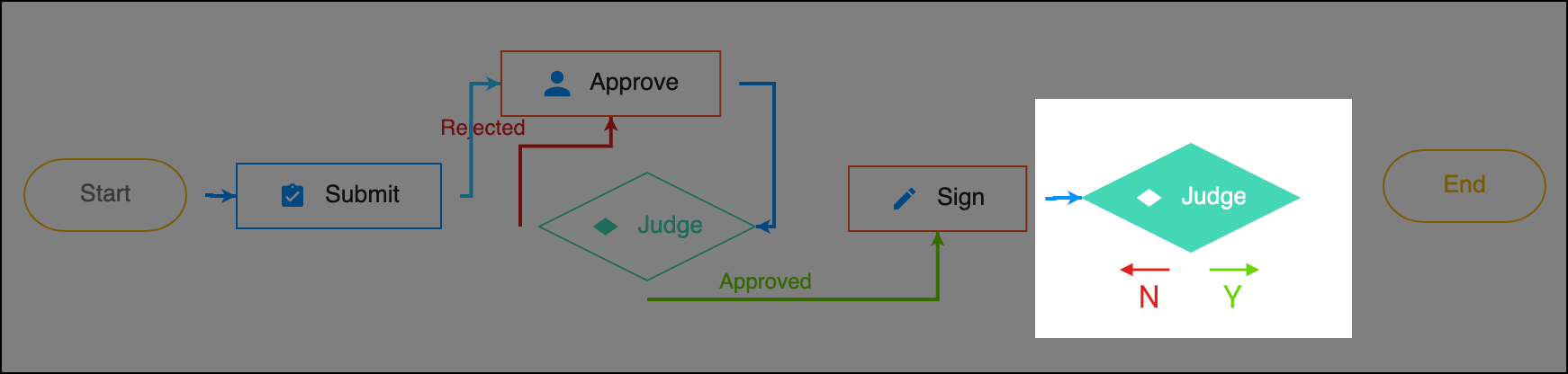 Figure 7. Selecting Judge node to access Y/N options
-
Select the N option and join one of the gray dots to the needed node to provide the rejection outcome connection.
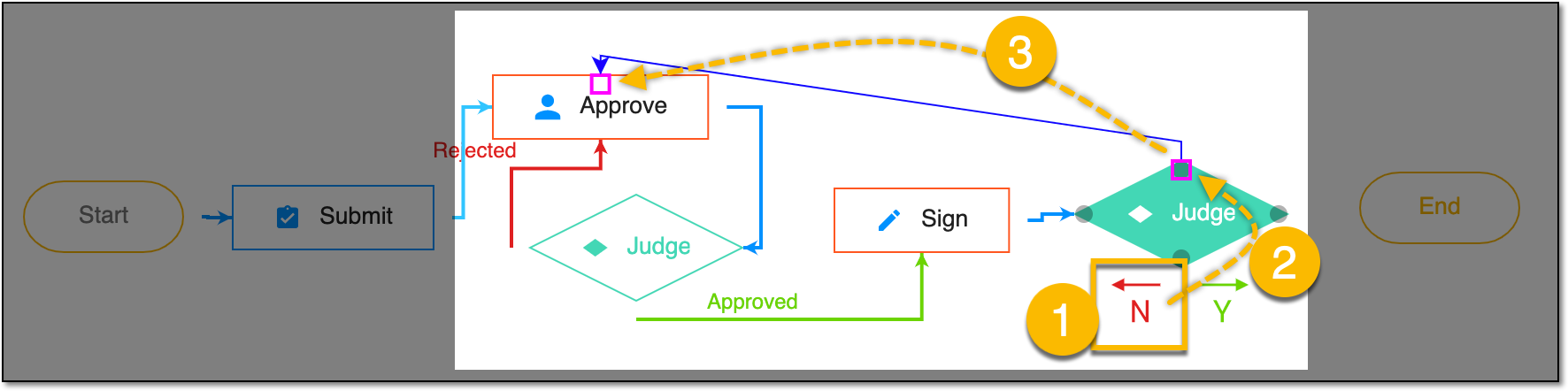 Figure 8. Providing rejection connection for N option
-
Select the Y option and join one of the gray dots to the needed node to provide the approval outcome connection.
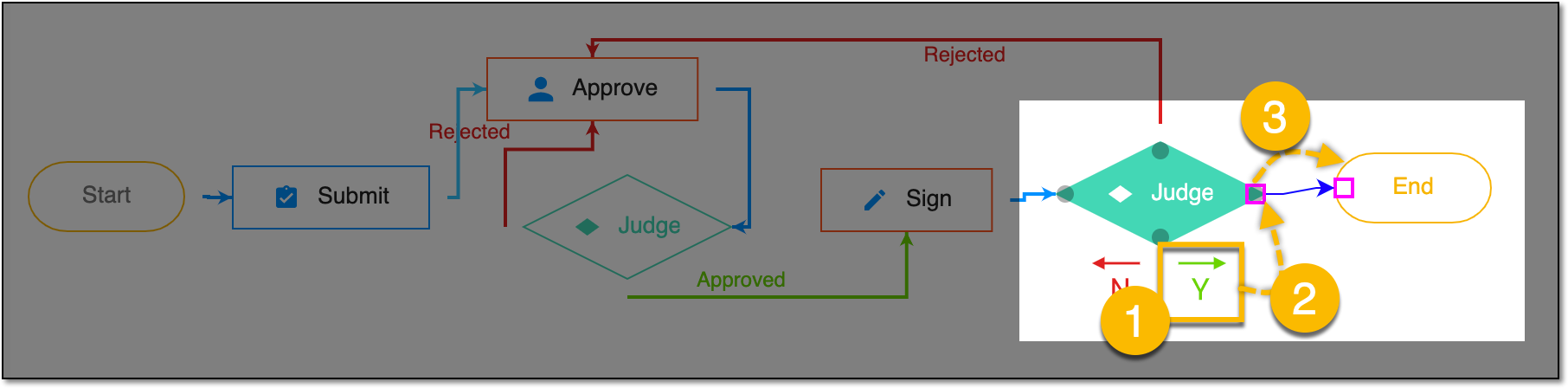 Figure 9. Providing approval connection for Y option
For instance, you need to outline the following logic of the file signature:
-
If signed, the workflow ends.
-
If rejected, the approval stage is reinitiated.
Thus, you add the Sign node to the workflow, and the Judge node appears with it by default. First, you draw the approval connection by selecting the Y option of the Judge node and connecting one of the node's gray dots to the End node. Then you draw the rejection connection by selecting the N option and joining one of the gray dots to the Approve node. You have outlined both approval and rejection logic for your file signature.
-
-
After the task nodes are linked, add or modify details for the Submit, Approve, Sign, and Co-sign task nodes (if added). To add the details, double-click the task node or select the task node and then, from the workspace toolbar, select Edit
 .
. -
In the panel that expands, configure the task node details as follows.
The available settings of the Submit node are explained in the following table.
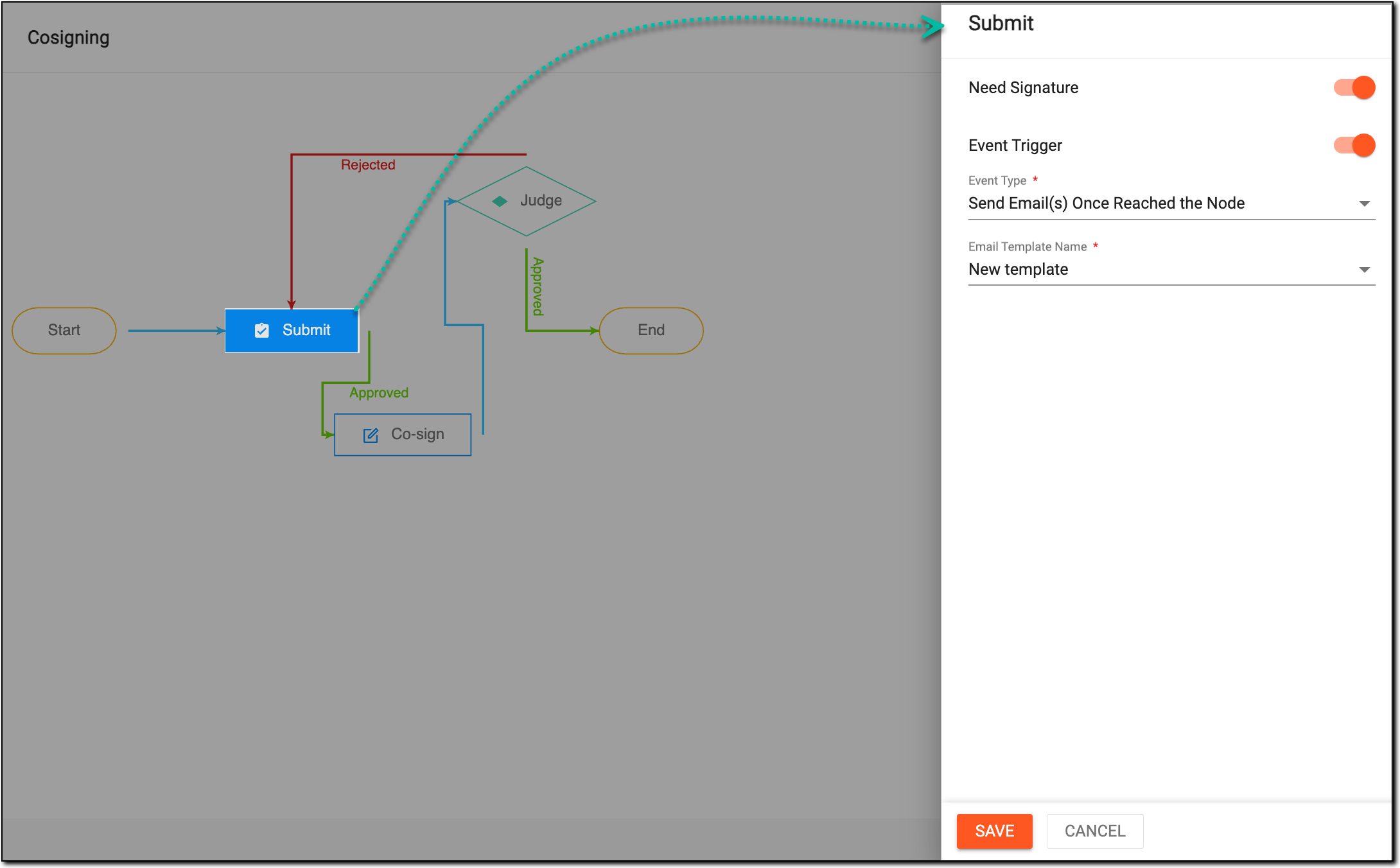 Figure 10. Configuring submission node
Tip
In the following table, mandatory elements are marked with an asterisk (*).
Element
Details
Need Signature*
-
Turn on this toggle to make a signature mandatory upon the file submission.
-
Turn off this toggle to make a signature mandatory upon the file submission.
Event Trigger
-
Turn on this toggle if you want to send an email to the recipients of the workflow when the specified event occurs. Upon turning this toggle on, the following fields appear:
-
Event Type: select the category of the occasion for which you want to initiate the trigger.
-
Email Template Name: select the format in which you want to send the email when the event occurs.
-
-
Turn off this toggle if you do not want to receive any email upon the occurrence of any event.
SAVE
Select
 to save your changes.
CANCEL
Select
 to discard your changes and return to the workflow designer.
The available settings of the Approve node are explained in the following table.
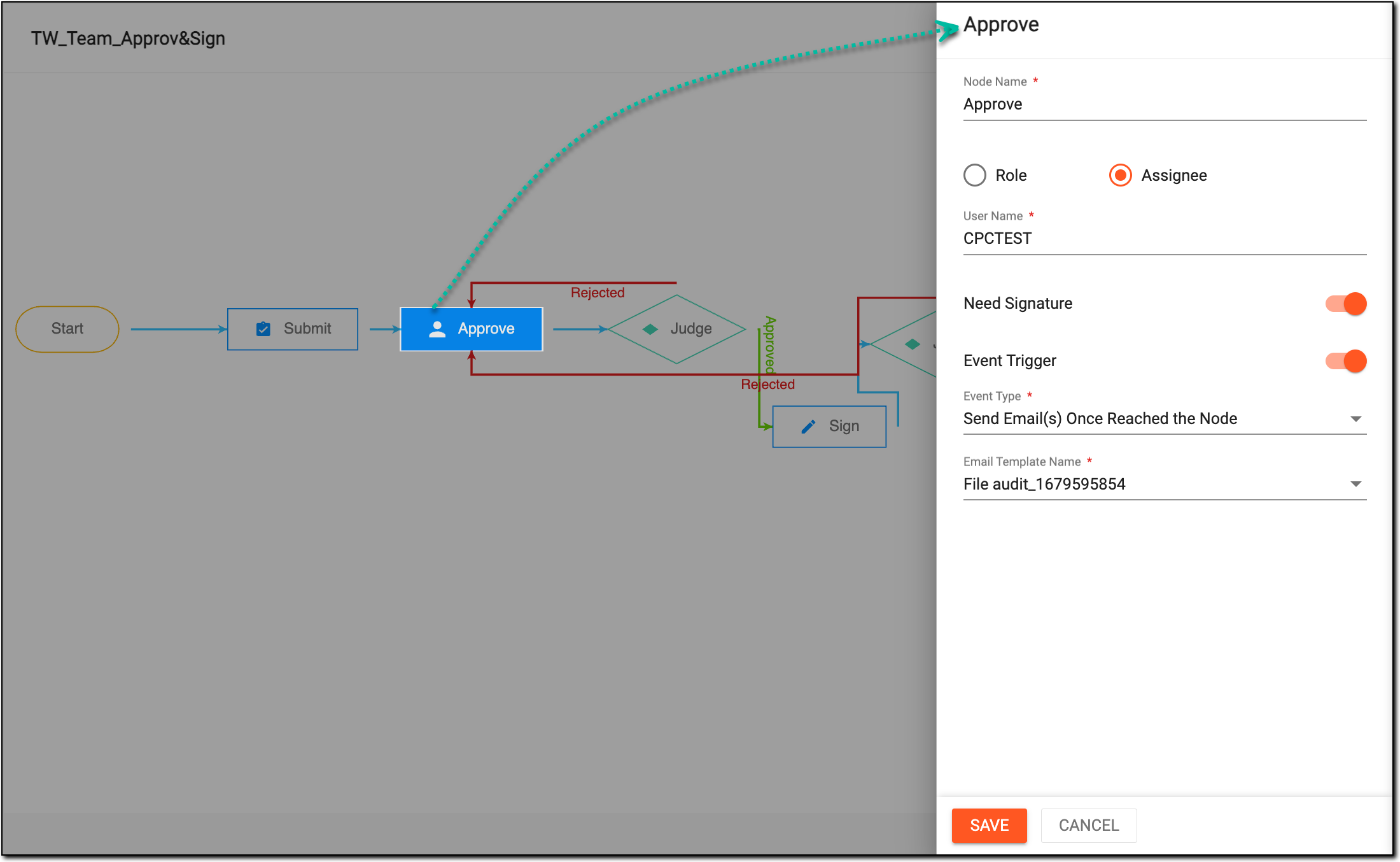 Figure 11. Configuring approval node
Tip
In the following table, mandatory elements are marked with an asterisk (*).
Element
Details
Node Name*
Enter the name of the task node.
The node name in each workflow needs to be different. If in a specific workflow, you enter the same node name twice, an error prompt is displayed, and the changes cannot be saved.Role
Select this option if your action requires seeking approval from a role, such as DM, PI, or others. Then, from the Role dropdown list that appears, select the required role.
Assignee
Select this option if your action requires seeking approval from a specified user. Then, in the User Name field that appears, select the required user(s).
Need Signature
-
Turn on this toggle to make a signature mandatory upon the file submission.
-
Turn off this toggle to make a signature mandatory upon the file submission.
Event Trigger
-
Turn on this toggle if you want to send an email to the recipients of the workflow when the specified event occurs. Upon turning this toggle on, the following fields appear:
-
Event Type: select the category of the occasion for which you want to initiate the trigger.
-
Email Template Name: select the format in which you want to send the email when the event occurs.
-
-
Turn off this toggle if you do not want to receive any email upon the occurrence of any event.
SAVE
Select
to save your changes.CANCEL
Select
to discard your changes and return to the workflow designer.The available settings of the Sign node are explained in the following table.
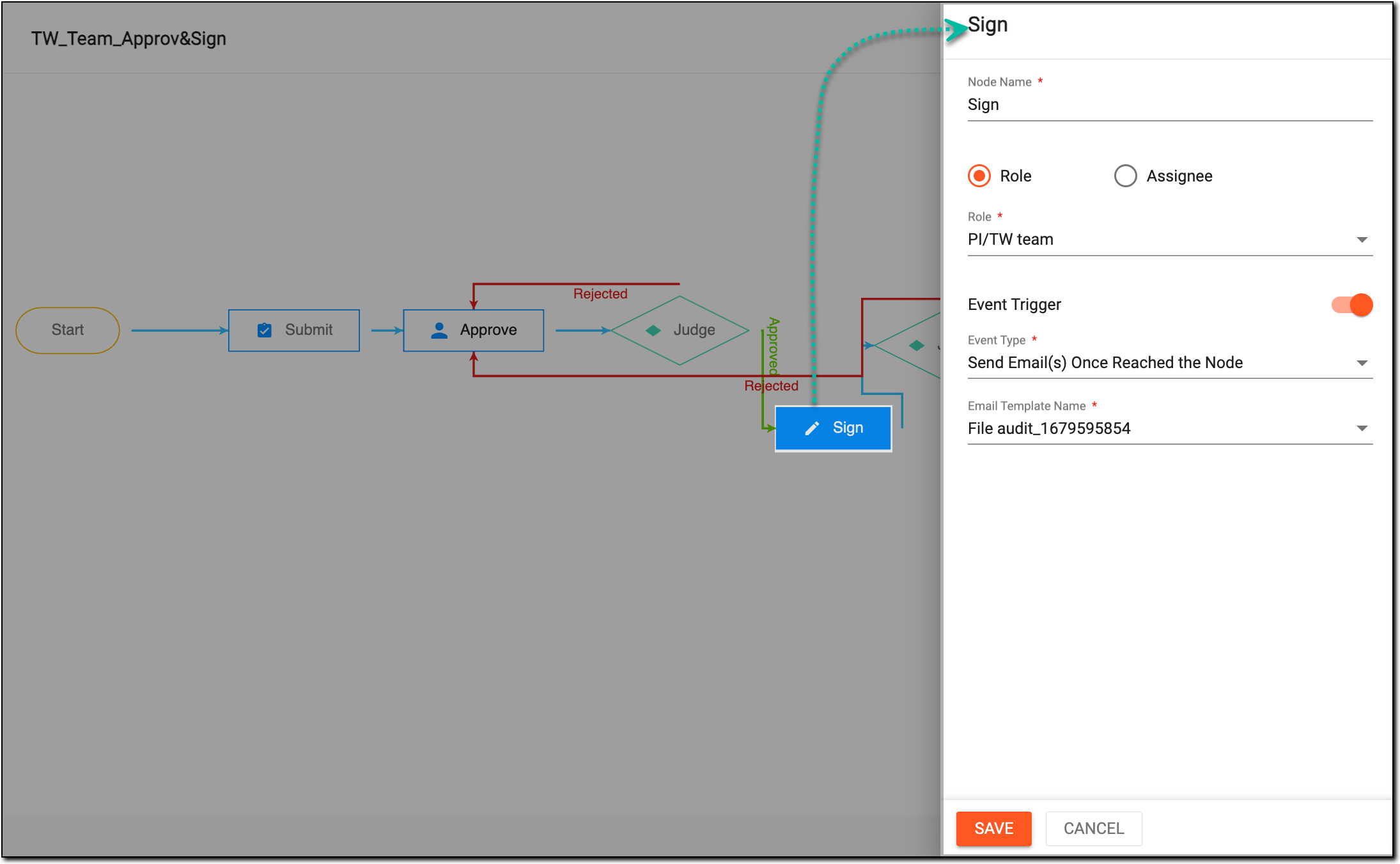 Figure 12. Configuring signature node
Tip
In the following table, mandatory elements are marked with an asterisk (*).
Element
Details
Node Name*
Enter the name of the task node.
The node name in each workflow needs to be different. If in a specific workflow, you enter the same node name twice, an error prompt is displayed, and the changes cannot be saved.Role
Select this option if your action requires seeking approval from a role, such as DM, PI, or others. Then, from the Role dropdown list that appears, select the required role.
Assignee
Select this option if your action requires seeking approval from a specified user. Then, in the User Name field that appears, select the required user(s).
Need Signature
-
Turn on this toggle to make a signature mandatory upon the file submission.
-
Turn off this toggle to make a signature mandatory upon the file submission.
Event Trigger
-
Turn on this toggle if you want to send an email to the recipients of the workflow when the specified event occurs. Upon turning this toggle on, the following fields appear:
-
Event Type: select the category of the occasion for which you want to initiate the trigger.
-
Email Template Name: select the format in which you want to send the email when the event occurs.
-
-
Turn off this toggle if you do not want to receive any email upon the occurrence of any event.
SAVE
Select
to save your changes.CANCEL
Select
to discard your changes and return to the workflow designer.The available settings of the Co-Sign node are explained in the following table.
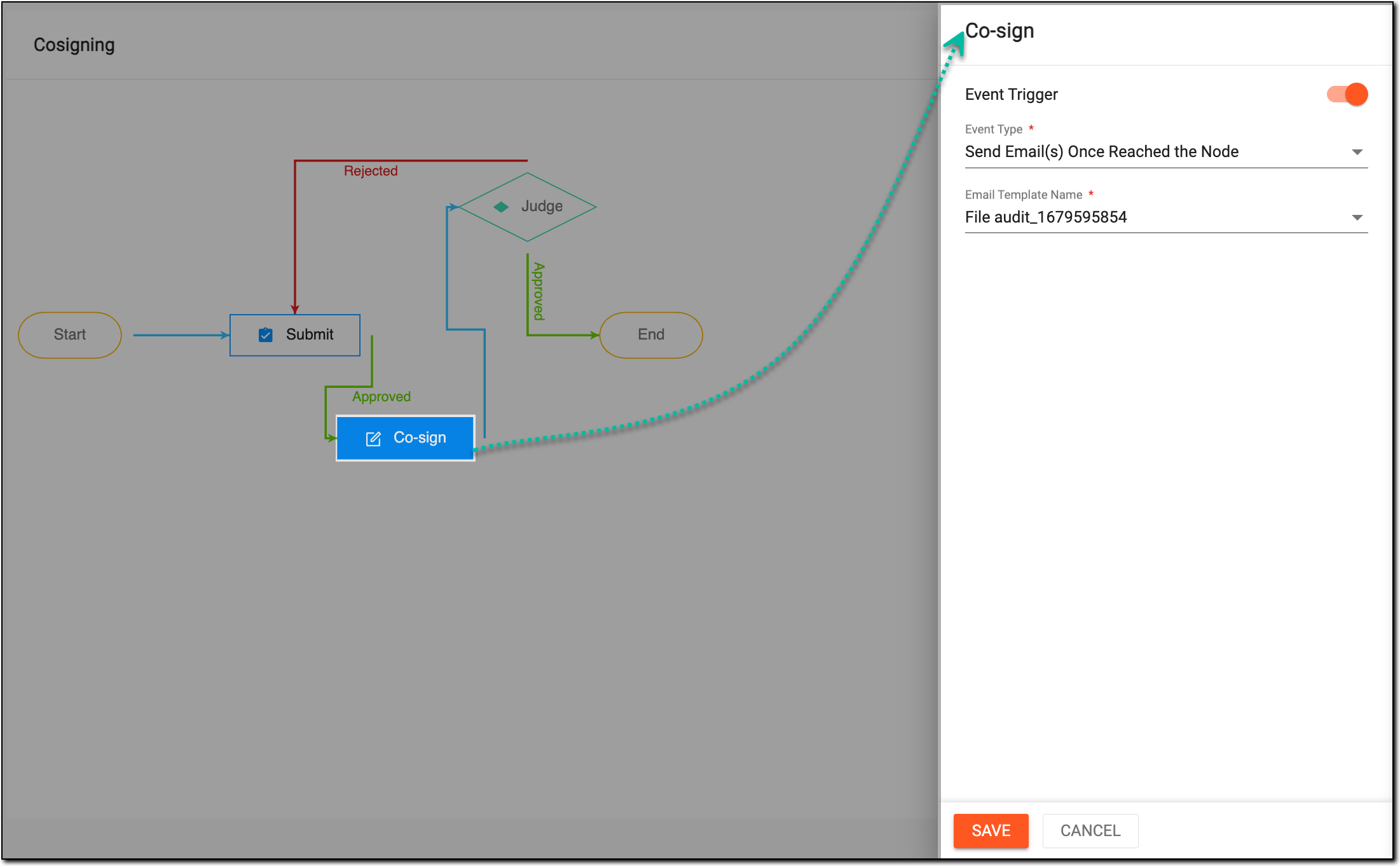 Figure 13. Configuring co-signature node
Element
Details
Event Trigger
-
Turn on this toggle if you want to send an email to the recipients of the workflow when the specified event occurs. Upon turning this toggle on, the following fields appear:
-
Event Type: select the category of the occasion for which you want to initiate the trigger.
-
Email Template Name: select the format in which you want to send the email when the event occurs.
-
-
Turn off this toggle if you do not want to receive any email upon the occurrence of any event.
SAVE
Select
to save your changes.CANCEL
Select
to discard your changes and return to the workflow designer. -
-
After all the nodes are linked and configured, select Save
 , and in the Workflow
dialog that appears, in the Workflow Name field, enter the workflow name.
, and in the Workflow
dialog that appears, in the Workflow Name field, enter the workflow name.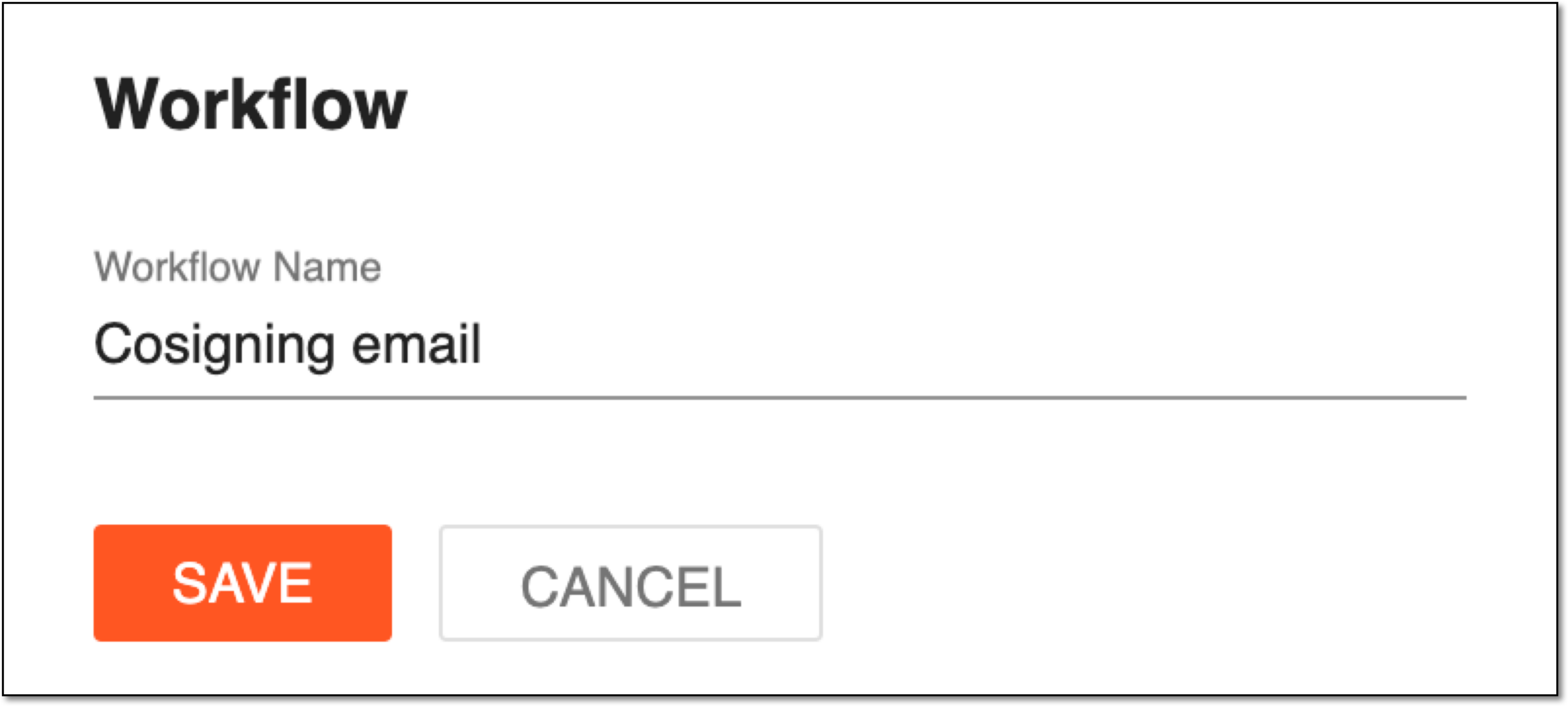 Figure 14. Entering workflow name
-
Select
 to save the changes.
Upon saving, the new workflow is added to the workflow list. You can now associate your workflow with a folder.
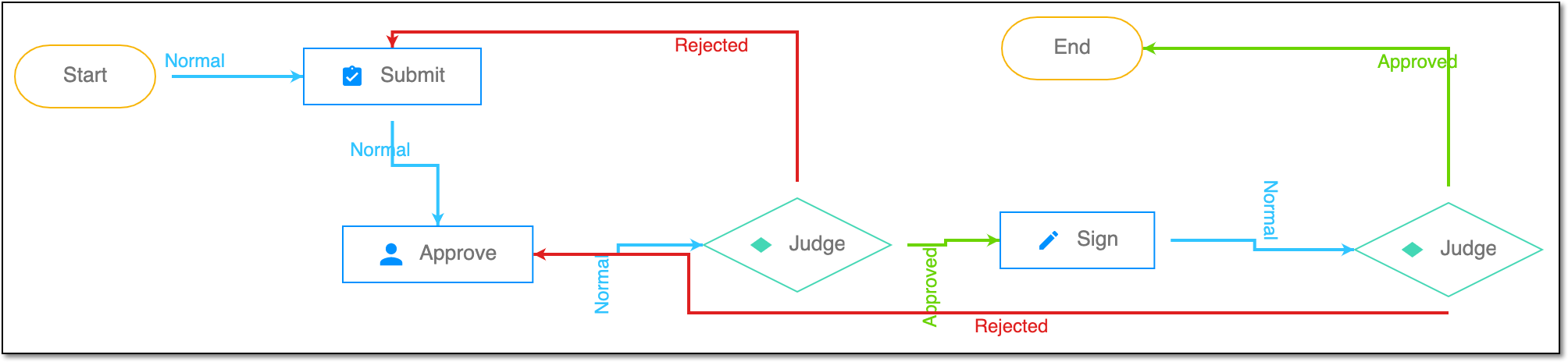
A schema, each step of which represents a stage of a specific entity lifecycle in the system.
A workflow can be considered an instrument to help control various actions on system entities for the sake of accountability, as it limits the actions that can be performed on the entity associated with a workflow. This provides an additional tier of scrutiny, and the approval/rejection mechanism reduces the risk of unintended impact on sensitive resources and important information.
 |
For instance, in eTMF, the workflow dictates the procedure of file and folder management from the moment of upload to the approval stage; in CTMS, the workflow controls the process of creation, completion, and approval of a trip report; in EDC, the workflow covers the process of source document handling.
An eClinical application that represents an administrative system used to manage users, authorities, and sponsors at the company level. It provides studies, sites, and sponsors with high-granularity role-based access management across all eClinical applications.
A person responsible for managing and ensuring the integrity, accuracy, and confidentiality of data collected during clinical trials. The DM’s scope of work might include maintaining the quality of data, complying with regulatory requirements, and supporting the overall success of clinical research.
In the eClinical system, the Data Manager (DM) user role is granted to a person who is mainly responsible for cleaning the data, making sure the data is entered correctly according to all requirements and industry standards, and creating manual queries for clinical research coordinators on any questionable data pieces. Before the study goes live, works with the sponsor and receives and addresses their feedback to set up the study and CRFs in EDC in a way that the sponsor approves.
A person responsible for overseeing and conducting the research study at a specific investigational site or multiple sites, depending on the study's design. The role of a PI is multifaceted and involves various responsibilities, such as study oversight, protocol adherence, participant recruitment and informed consent implementation, regulatory compliance, and so on.
In the eClinical system, the Principal Investigator (PI) role that is assigned to a person who oversees the data entering and signs off subjects—gives authorized confirmation that all the entered data is valid and follows the industry standards. The responsibilities of PI can vary depending on study requirements.