View text references
The Study Designer application provides the capability to translate CRF texts into multiple languages. This provides a significant advantage in global clinical trials where participants speak different languages. By addressing diverse linguistic needs, CRF translation promotes standardized data collection across international sites.
When you have all the target texts generated, they are ready to be translated into specific previously applied languages. Before or during the translation process, you can view references for each target text to learn about its exact application within the specific CRF version to better understand the contextual usage and phrasing.
-
In the Study Designer application header, select the TRANSLATION tab.
 Figure 1. Accessing CRF translation functionality
-
From the toolbar, select the latest draft CRF version, otherwise, you cannot update translations.
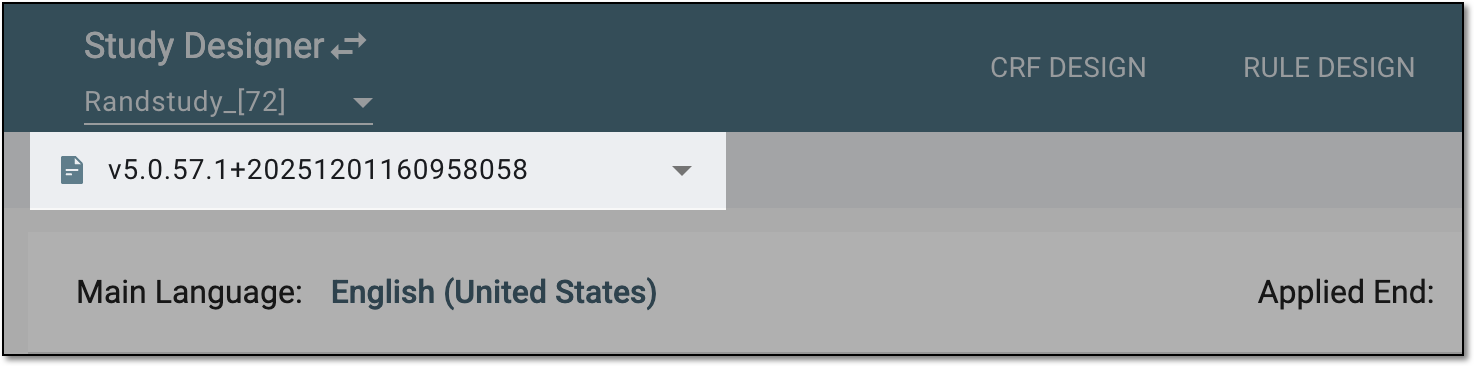 Figure 2. Selecting draft CRF version
-
From the Applied End field, select the application where the data is to be collected and from Translation Language, select the language of translations for the target texts.
 Figure 3. Selecting applied end and translation language
-
Then select the tab to access the needed texts and translations as follows:
-
By Target: to access target texts and their respective translations disregarding their location in the current study design.
-
By Location: to access the texts of the CRF items (currently, only codelist items) and their respective translations, organized by their location in the current study design.
Tip
You can also check the location of the text by viewing the ODM element path.
 Figure 4. Accessing translations by target texts or location
-
-
In the table that appears, next to the needed target text, select Reference Object
 .
. Figure 5. Accessing text references
-
On the Reference Object page that opens, view target text references under different tabs. These tabs represent the entities for which the text is used in the CRFs; for example, the Question tab lists the locations where the text is used in questions, and the Item Caption tab has the list of locations where the text is used as an item caption.
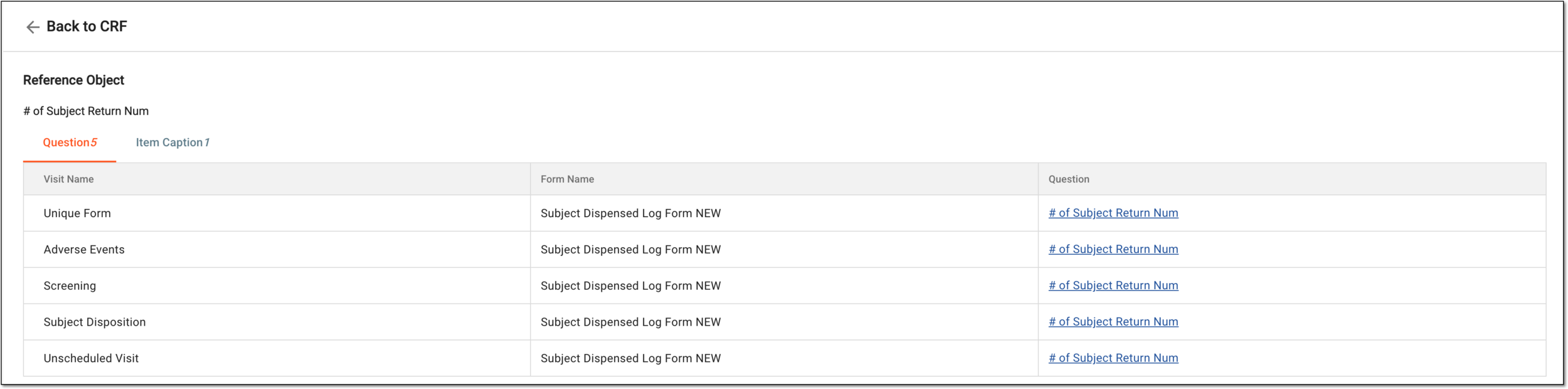 Figure 6. Viewing text references
You have analyzed the list of target text references.