Analyze conversion factor and range report
A conversion factor is defined as a numerical digit used to convert different units used for measuring lab tests to SI units. The laboratory tests conducted in different countries have different measurement units. The conversion factor is used to standardize the lab test data recorded in the EDC system to a common measuring unit used internationally for unified data analysis and result assessment.
For instance, hemoglobin is measured to attain results of red blood cells. In some areas, it is measured in grams per deciliter (g/dL) and in others, in grams per liter (g/L). Since liter is the preferred unit internationally, all the values calculated in g/dL need to be converted to g/L. The conversion factor in this case is 10, and to have a standardized unit in all the tests, all the values measured in g/dL are converted to g/L by multiplying by 10.
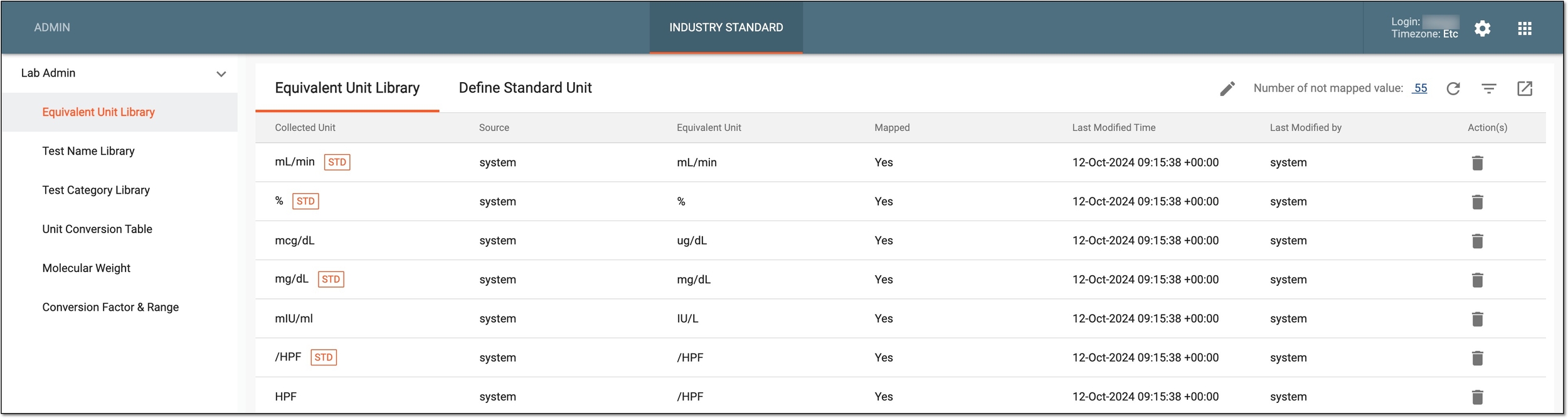
The conversion factors for lab tests and normal ranges are set in Lab Admin and the data is automatically synced between EDC and Lab Admin on the preset schedule. You can view the details of all these conversion factors used to convert the units of various lab tests along with the details of the acceptable ranges of the lab tests. This helps you analyze the list of conversion factors used within the system and the normal ranges available for particular tests entered in the system.
-
In the EDC application header, select the STUDY INFO tab.
-
In the left pane, expand the Lab subtab.
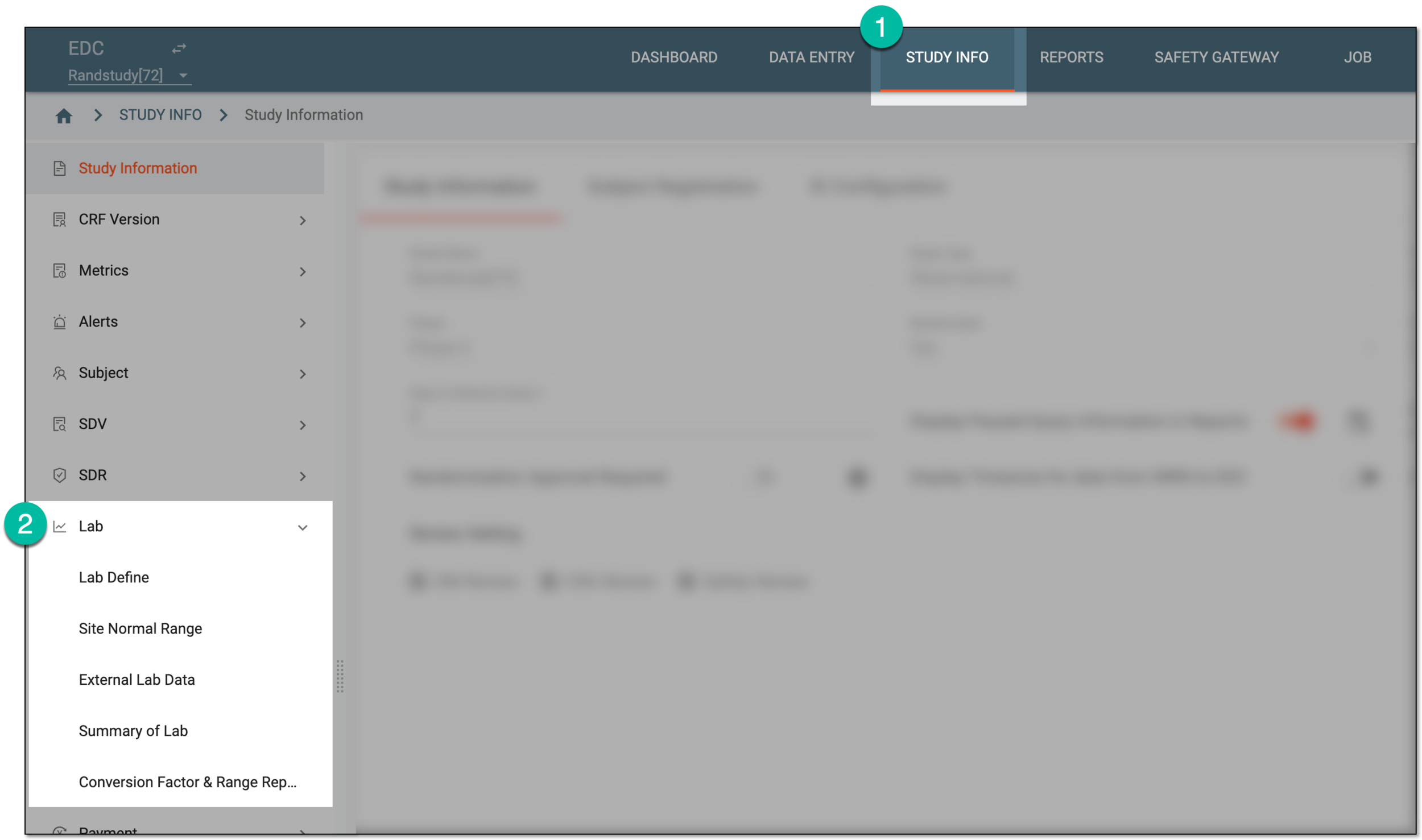 Figure 1. Accessing lab management
-
From the list that appears, select Conversion Factor & Range Report.
-
On the Conversion Factor & Range Report, from the workspace toolbar, select Refresh
 and in the table that appears, analyze the attributes as explained in the following table.
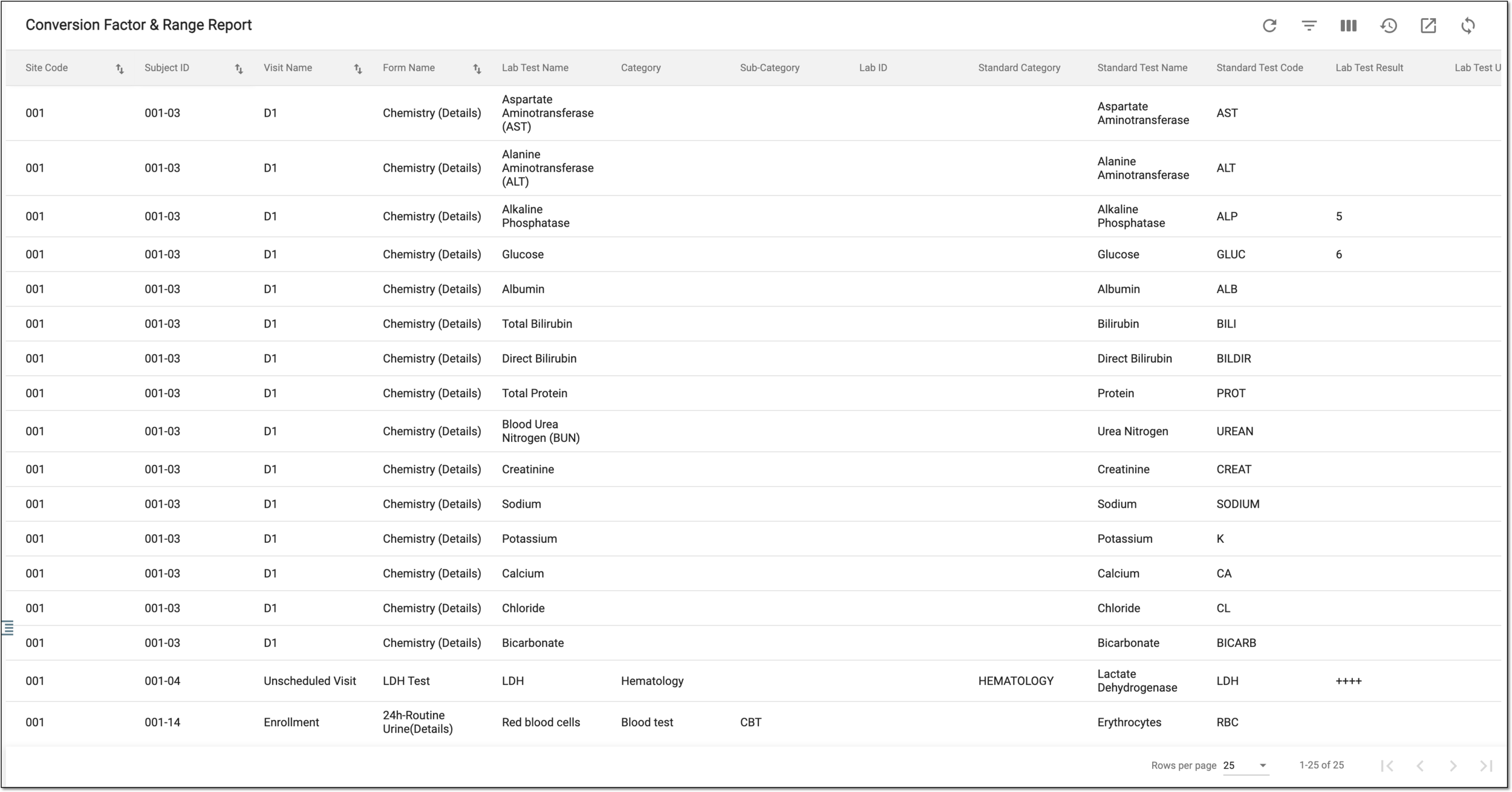 Figure 2. Conversion factor & range report
Tip
Select Sync the limit range value to the lab range check value
 from the workspace toolbar to manually
sync data between EDC and Lab Admin if required. Note that the data sync operation can only be performed once a day.
from the workspace toolbar to manually
sync data between EDC and Lab Admin if required. Note that the data sync operation can only be performed once a day.Element
Details
Site Code
Represents the unique identifier of the site where the lab test is performed.
Subject ID
Represents the unique identifier of the subject for whom the lab test is performed.
[Additional ID]
Represents the additional unique identifier of the subject—if configured for your study—for whom the lab test is performed.
This can be Screening ID assigned to subjects at the stage of screening—evaluation—for participation.
Visit Name
Represents the name of the visit at which the lab test is performed.
Form Name
Represents the name of the case report form (CRF) in which the lab test results are recorded.
Lab Test Name
Represents the name of the lab test, for instance, Bilirubin or pH.
Category
Represents the category of the lab test, for instance, Hematology or Urinalysis.
Sub-Category
Represents the subcategory of the lab test.
Currently, in the EDC application, the subcategory value is not used. This value is preset for studies that use the domain name (LB, DM, and so on) as a category, then the subcategory is Hematology, Urinalysis, and so on.Lab ID
Represents the ID of the lab where the test is performed and whose normal ranges are used to assess test results.
Standard Category
Represents the classification of the lab test that is defined by a clinical industry. These are based on unique measures defined by the clinical industry that are not available in the system.
For instance, the Chemistry++ category refers to the advanced level of chemists and chemical procedures that take place for the test.
Standard Test Name
Represents the name of the lab test that is defined by a clinical industry. These are based on unique measures defined by the clinical industry that are not available in the system.
For instance, the standard test name of Chemistry++ can be LACTATE DEHYDROGENASE, which is a category of enzyme found in tissue, and the test conducted for it requires advanced chemical procedures.
Standard Test Code
Represents the unique identifier used by the clinical industry to refer to the lab test, for instance, the code for LACTATE DEHYDROGENASE is LDH.
Lab Test Result
Represents the result of the lab test conducted.
Standard Lab Test Result
Represents the result of the classified lab test that is defined by a clinical industry.
Conventional Lab Test Result
Represents the result of tests conducted in countries using units that vary from the global standards.
For instance, the mass is measured in kg worldwide and in lb in the US.
SI Unit
Represents the unit to which all the lab tests are converted that are initially measured in a different unit.
For instance, some tests are measured in deciliters and the SI unit is in liters. Once all the tests are measured the values in deciliters are converted to liters.
SI Lower Limit
Represents the baseline value of the reference range when converted to the SI unit. It is basically the lowest value of the lab test converted to the SI unit.
SI Upper Limit
Represents the peak value of the reference range when converted to the SI unit. It is basically the highest value of the lab test converted to the SI unit.
Conventional Unit
Represents the conventional unit in which the lab test is measured if any. Conventional unit in general refers to such unit that does not come under the SI unit.
Conversion Factor (SI Unit -> Conventional Unit)
Represents the coefficient used to convert the SI unit of the lab data point into a conventional unit.
Conventional Unit Lower Value
Represents the baseline value of the conventional lab test. Any value lower than this value is considered abnormal.
Conventional Unit Upper Value
Represents the peak value of the conventional lab test. Any value higher than this value is considered abnormal.
Lower Limit
Represents the baseline value of the lab test. Any value lower than this value is considered abnormal.
Upper Limit
Represents the peak value of the lab test. Any value higher than this value is considered abnormal.
Standard Lower Extreme Limit
Represents the utmost baseline value of the standard lab test. The range reported within this limit requires immediate action.
Standard Upper Extreme Limit
Represents the utmost baseline value of the standard lab test. The range reported within this limit requires immediate action.
Conversion Factor (Lab Test Unit -> SI Unit)
Represents the value used to convert the conventional lab test to the closet SI unit.
You have analyzed the conversion factor and range report.
A system of measurement used worldwide. It provides a precise framework to measure the range of quantities. It is based on the following seven base fundamental units, from which the further units are derived:
-
Meter (m)
-
Kilogram (kg)
-
Second (s)
-
Ampere (A)
-
Kelvin (K)
-
Mole (mol)
-
Candela (cd)
A set of acceptable values acquired from the conducted laboratory tests to assess the subject's health condition. Normal ranges are expressed as precise numeric values, often with units of measurement, to judge if the test result is normal or abnormal.
A module of the eClinical administrative system that enables users to configure and maintain laboratory test assessment and unit conversion rules for the EDC application to follow.
A specialized document in a clinical trial designed to collect the subject data.
See also eCRF.
A specific area or category of data within a clinical trial that encompasses a set of related variables that share a common theme. Each domain organizes data to facilitate analysis and reporting, ensuring that information is structured and easily interpretable.
For example, in a clinical trial, domains might include demographics, efficacy, safety, and laboratory results.