Overview of CODING process
The CODING application integrates with both the eClinical Study Designer (SD) and Electronic Data Capture (EDC) applications, as well as external EDC systems, to standardize and process medical terms effectively. This integration ensures seamless data management across the study lifecycle, from initial design to data collection and coding. In this section, you will find a detailed overview of the entire process.
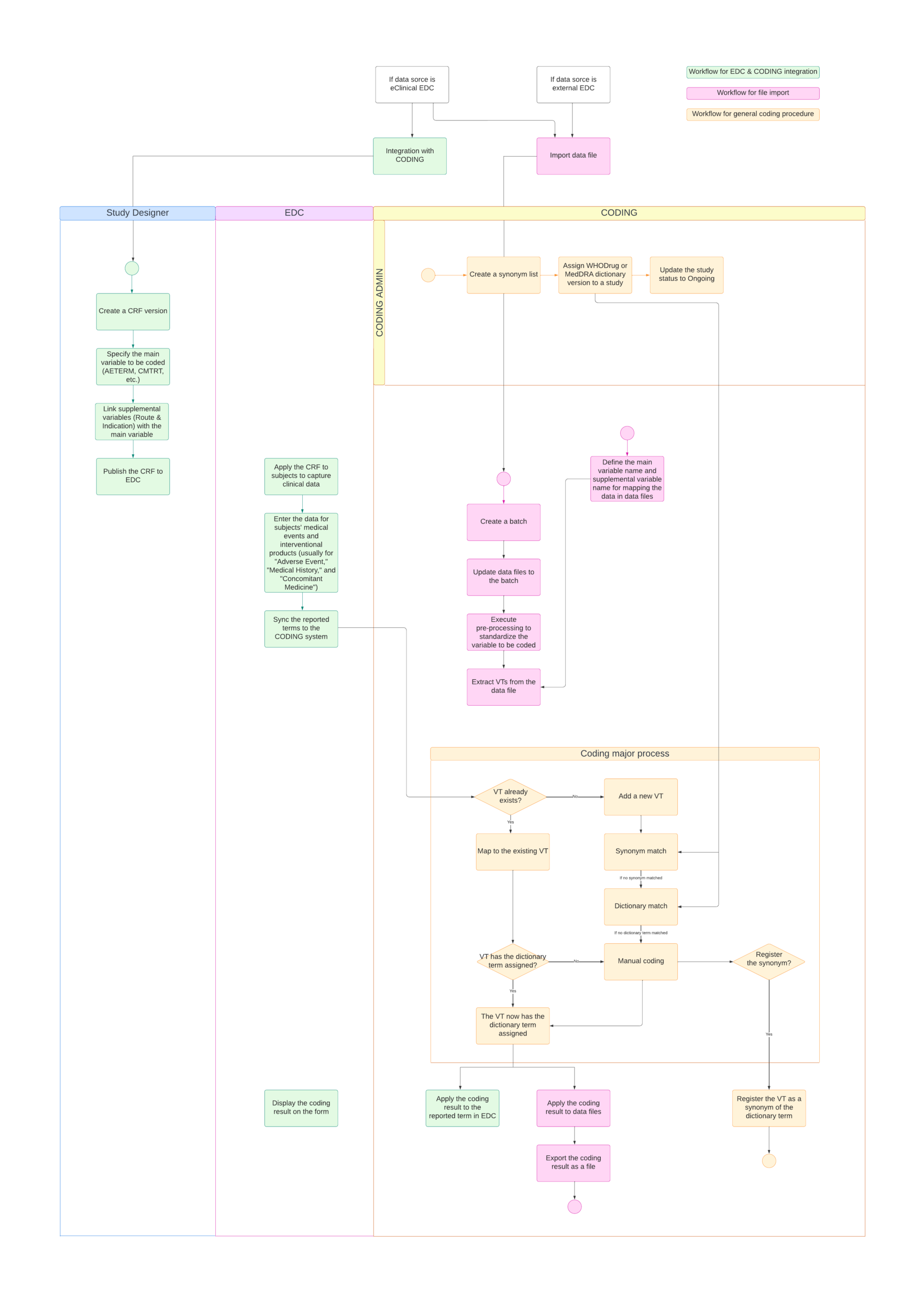
The process begins in the SD application where a Case Report Form (CRF) version is created. The main variables to be coded (such as adverse events, medical history, or concomitant medications) are specified, and supplemental variables like route and indication are linked with the main variable. Once the CRF is completed, it is published to the EDC system.
Within the EDC system, the CRF is applied to capture clinical data from subjects. Data entry includes medical events and interventional products, ensuring that all relevant medical terms are reported accurately. The reported terms are then synced to the CODING system, using direct integration for seamless data transfer. For data sources outside EDC, the reported terms are imported manually into the CODING system.
In the Coding Admin module of the CODING system, administrators handle the configuration necessary for the studies' coding processes. This includes creating and managing synonym lists, assigning WHODrug and MedDRA dictionary versions to a study, and updating the study status, for example, to Ongoing, Upgrading, and others. These company-level configurations ensure that the Medical Coding module operates within the defined parameters and maintains consistency across studies.
In the Medical Coding module, the actual coding process is carried out. It involves the following steps:
-
Creating a batch: for data from external EDC systems, a batch is created to organize the data files.
-
Uploading data files: data files are uploaded to this batch.
-
Pre-processing data (for imported files only): raw data from imported files undergoes pre-processing. This step is essential for standardizing the variables that need to be coded, although it is not required.
-
Splitting data (for imported files only): if necessary, the data is split into smaller, more specific terms based on predefined split rules or through manual splitting. Be careful with this step, as splitting changes the original data structure, leading to coding results that cannot be mapped to the original data. Coders are advised to split the originally reported terms only if the data is locked and the clinical research coordinator (CRC) cannot modify the data in the EDC system.
-
Extracting Verbatim Terms (VTs): the verbatim terms that need to be coded are extracted from the (pre-processed) data files. The Medical Coding module takes over at this point, using auto-coding to match these terms against the WHODrug and MedDRA dictionaries. This process involves three key stages:
-
Dictionary match: the CODING application tries to find an exact match for the verbatim term in the medical dictionaries.
-
Synonym match: if an exact match is not found, the application searches for synonyms.
-
Manual coding: for terms that cannot be autocoded, manual matching is performed by the coder. Coders can also register new synonyms of the dictionary terms to ensure consistency across studies.
-
Once the coding process is complete, the following steps occur:
-
Display the coding result on the CRF form: the coding results (the standardized terms) are displayed on the corresponding CRFs within the eClinical EDC system, allowing users to view and verify the results.
-
Apply the coding result to the reported term in EDC: the coded terms are applied to the reported terms in the external EDC systems, ensuring the data is updated and standardized across all systems.
-
Export the coding result as a file: the standardized coding results can be exported as data files in various formats, including .sas7bdat, .csv, and .xlsx, making it versatile for different analytical needs.
This entire flow is designed to ensure that medical terms are consistently and accurately coded, supporting reliable data management and analysis within medical studies.