Introduction to EDC
Electronic Data Capture (EDC) is a part of the eClinical platform that is designed to collect, store, and standardize subject data in a clinical trial just like all the EDC systems in the industry.
The data capture in a clinical trial is a unified and regulated procedure. With EDC capabilities, you can comply with all the essentials of this process. You can capture, structure, and amend all the subject data during or after they visit sites. Also, you have control over all the amendments due to an efficient reports system. The set of different level permissions for all the application users prevents data corruption and inappropriate usage. All the user roles work strictly with the functionality and data to which they have access to enhance the efficiency of the whole process.
Configurable per each study, EDC covers all the needs for data collection at each phase of a subject's lifecycle in a clinical trial. Thus, you achieve complete, unified, and structured data for further analysis and processing in other eClinical products with which EDC is highly integrated.
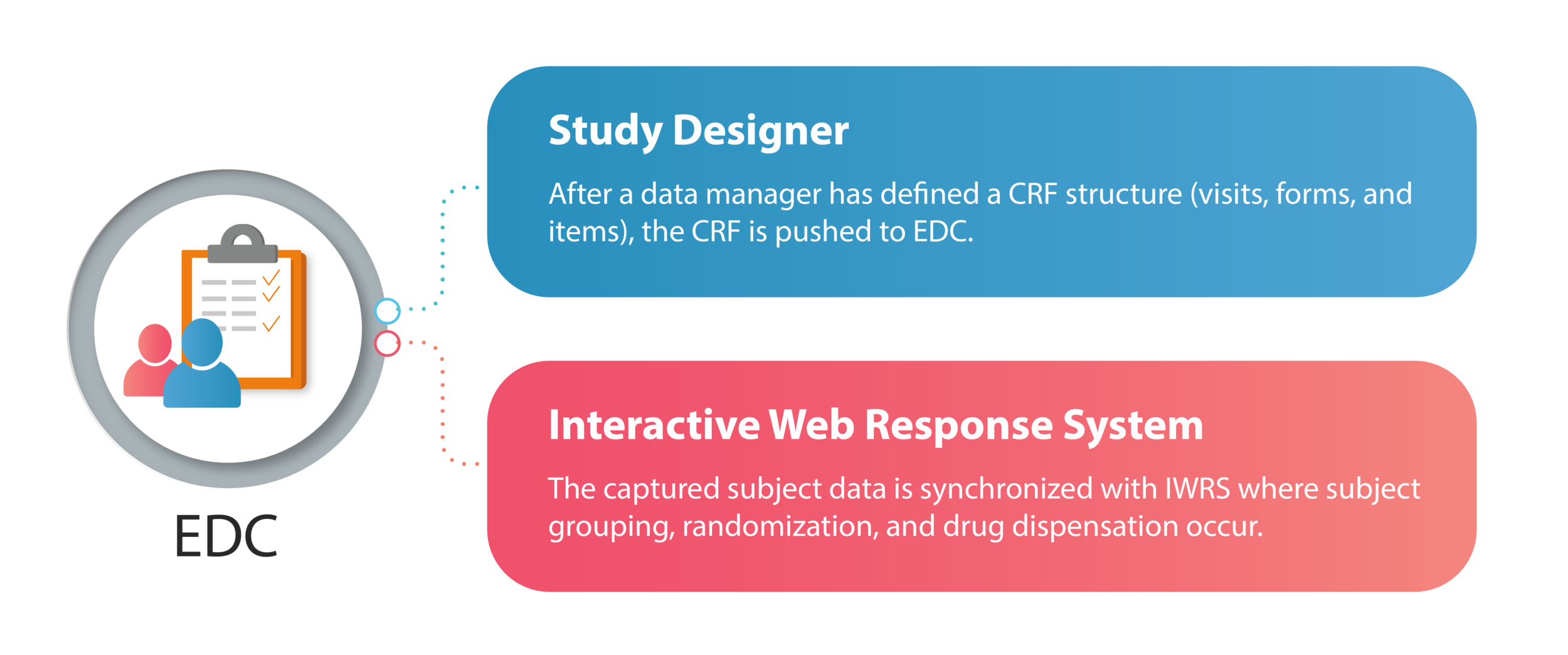
In eClinical, every product helps you manage a specific process of the clinical trial. For example, the data capture and CRF completion for a subject happen in EDC, while the CRFs themselves are preconfigured in Study Designer (SD), and the data from EDC serves as a basis for further subject grouping and randomization in Interactive Web Response System (IWRS). Thus, we can say that EDC is highly integrated with two other eClinical applications: SD and IWRS.
In EDC, the data capture happens according to CRFs, visits, phases, and other configurations designed in the SD application and based on the randomization and grouping processes, that take place in IWRS.
The basic correlation of these applications is depicted in the following schema.
Important
Depending on the SD configurations, subject data can be synchronized between EDC and IWRS to determine grouping, randomization, and drug dispensing processes, and the results of drug dispensing in IWRS can also be recorded in EDC as subject data.
In the EDC application, your access to the available features and data depends on the user role assigned to you via the ADMIN application. Here, you can find the recommended set of user roles to be configured in EDC.
Tip
Recommended here means that these roles are configured by default and can be used as they are. In addition to/instead of these roles, each company can create/request the creation of its user roles with different access privileges per its business needs.
The recommended set of business user roles is as follows.
-
Clinical research coordinator (CRC) is a person who works on a site with subjects and is responsible for entering data into EDC, making sure the data is entered correctly according to all requirements, and answering queries from the data manager on any questionable data pieces. In ADMIN, such a person is assigned the CRC role.
-
Data manager (DM) is a person who is mainly responsible for cleaning the data, making sure the data is entered correctly according to all requirements and industry standards, and creating manual queries for CRC on any questionable data pieces. Before the study goes live, works with the sponsor, and receives and addresses their feedback to set up the study and CRFs in EDC in a way that the sponsor approves. In ADMIN, such a person is assigned the DM role.
-
Clinical research associate (CRA) is a person who has a monitoring role and works with the sites. In EDC, CRA mainly has to make sure that the entered data is valid against the source document. CRA checks the source document in a process called SDV (source data verification) and ensures that everything entered by CRC is valid to avoid any discrepancies. In ADMIN, such a person is assigned the CRA role.
-
Principal investigator (PI) is a person who oversees the data entering and signs off subjects—gives authorized confirmation that all the entered data is valid and follows the industry standards. The responsibilities of PI can vary depending on study requirements. In ADMIN, such a person is assigned the PI role.
-
Sponsor is a person, company, organization, or any other party that is a client of EDETEK and a user of the eClinical system. The sponsor oversees the data entry and management as per their own business needs. Before the study goes live, the sponsor works closely with the DM, configuring CRFs and other aspects to ensure everything is according to their needs before giving the green light for the study to go live. In the course of a trial, the sponsor makes requests for amendments in the system according to the new protocol version, business requirement changes, or other needs. In ADMIN, a person who is the sponsor's representative is assigned the Sponsor role.
These user roles are configured and granted access permissions and other privileges according to each sponsor's needs per study.
In the clinical research industry, a software that is used to collect and store subject data in the clinical trial process in a permanent electronic form.
A specialized document in a clinical trial designed to collect the subject data.
See also eCRF.
An eClinical application that provides functionality to design and configure a study (clinical trial), namely to configure CRFs, set subject phases, visits, and others.
The application supports the design of the CDSIC ODM-compliant electronic CRFs to support EDC and eDiary data collection and management.
Get to know all the possibilities of the app with the comprehensive SD User Guide.
A process of assigning subjects to different cohorts based on the inclusion criteria.
A process during which subjects receive their random numbers and are assigned to different arms based on the randomization scheme.
An eClinical application that represents unified and configurable subject randomization and trial supply management tool for subject grouping, drug inventories, shipments, and dispensations, as well as other vital processes during a clinical trial.
Get to know all the possibilities of the app with the comprehensive IWRS User Guide.
An occurrence in a clinical trial in which the subject comes to a site to receive treatment, undergo some tests, or complete other required procedures.
A specific phase that a subject has to complete in the course of a clinical trial to move further to the next phase. For instance, Screening, Enrolled, Randomized, and others.
 |
In eClinical, subject phases are designed individually for each study via the SD application, although they are referenced in others, like IWRS or EDC.
An eClinical application that represents an administrative system used to manage users, authorities, and sponsors at the company level. It provides studies, sites, and sponsors with high-granularity role-based access management across all eClinical applications.
In a clinical trial, a location where the subject treatment and drug dispensation occur. It can be a hospital, a private laboratory, or other institutions.